Why Pioneer Fund Bets on Manufacturing: Christopher Cipoletti talks Local Investment, Local Impact
While many investment firms chase high‑growth tech startups and billion‑dollar exits, Christopher Cipoletti has taken a different path. As Managing Director of Pioneer Fund, he focuses on acquiring and growing small to midsize manufacturing companies across Colorado’s Front Range. His approach blends private equity discipline with a strong commitment to community development, workforce opportunity, and long‑term value creation.
In this interview, Cipoletti reflects on his journey from commercial litigator to private equity leader, why manufacturing matters to local economies, and how thoughtful investment can strengthen both businesses and the communities they serve.
Q: Much of the investment world is focused on chasing the next big thing like AI, software, or biotech. Why did you choose manufacturing?
We are very atypical. Pioneer Fund was founded to create quality jobs in the communities where our businesses operate, support the local economic base, and act as good corporate citizens.
We focus on manufacturing – primarily advanced manufacturing – largely because of experiences I had in the early 2000s. I was the chair of the Greater Colorado Springs Chamber of Commerce. During that time, we had lots of conversations about the fact that the Pikes Peak region has strong land development, nonprofits, and government contracting, but our privately owned small business community didn’t have the strength that it needed.
My career took me out of Colorado Springs. I lived here but I wasn’t really working in the community for a number of years. When I re‑anchored myself in Colorado Springs in 2017, I became involved again in the Pikes Peak region, and I recognized that 15 years later, we were still having the same conversations about the same needs.
As a result, we decided to start Pioneer Fund with a focus on small to midsize manufacturing businesses because manufacturing really seemed to be a critical need that could strengthen the Pikes Peak region and Colorado’s Front Range.
Q: Walk us through your journey from being a lawyer to leading Pioneer Fund.
I started my career as a litigator. I dealt with complex commercial litigation for 15 years and found that I was always dealing with people who were upset with each other. They were battling and they were in conflict and you could never or very rarely find a win‑win solution. Somebody wanted to win, and if somebody had to win, somebody had to lose.
I had an opportunity to transition out and work for a client as their CEO and executive director. I did that for five years. When I left, I started doing consulting work with small to midsize businesses, primarily family owned.
Most of them had grown to a certain level and then they got stuck. They would try to grow by adding a million dollars in revenue but would add a million and a half dollars in expenses to get that new revenue. Their growth was costing them profitability.
I started working with these businesses, doing some turnarounds, but focusing much of my work on growth. These were businesses that were profitable, and I helped them figure out how to grow in a way that made sense for them. For some of them that was growing their core existing business, and for some it was looking at add‑on areas that fit nicely.
I did that for about seven years, and all of my clients were outside the state of Colorado. I was living in Colorado and working outside the state. In the final year of that consulting work, I traveled 50 weeks out of the year. From a health and mental and spiritual standpoint, it was not a good place to be.
I decided I needed to make a change. I looked at the skills I had developed through consulting, my legal background, and my experience running an organization and considered where I could apply them.
I had worked with several private equity groups through some of my clients and thought, “We don’t have a private equity group in southern Colorado. Let’s see what we can do to build something where people who are supportive of the community – who want to see the community grow in a healthy way – could invest some money and invest some of their time to help build businesses.”
That’s what started Pioneer Fund.
Q: Why manufacturing from a personal perspective?
My father was an accountant for a multi-national manufacturing company. His entire career was in manufacturing. He started with Joy Manufacturing in Pittsburgh, got transferred a few times, and we landed in Colorado.
The company was sold several times, but he stayed with the core company on every sale. He was one of those people who after 40 years in his career retired with the gold watch.
We rarely see those today.
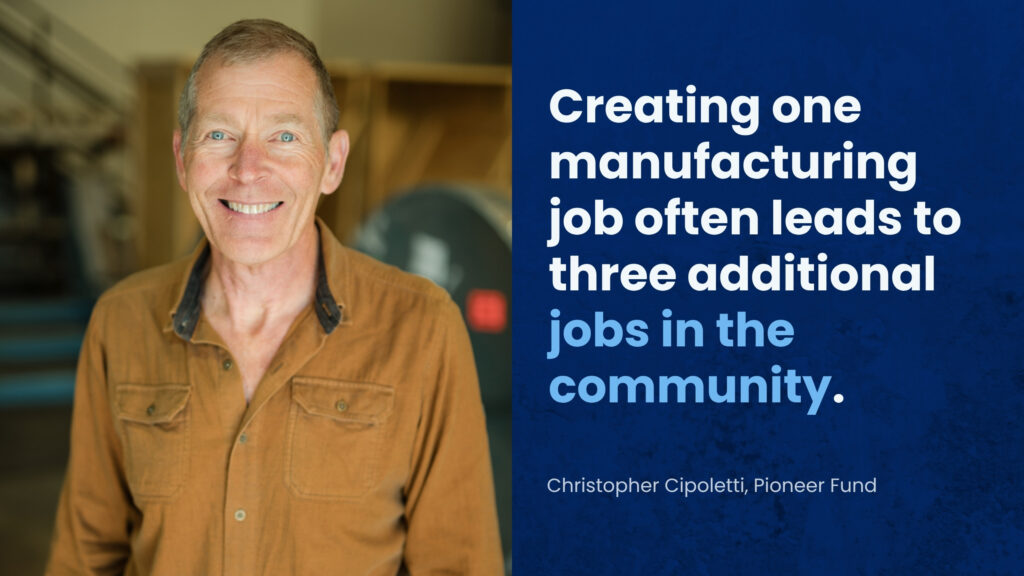
I grew up in a big manufacturing environment. When I started looking at what we should be doing with Pioneer Fund, part of our focus was job creation. With manufacturing businesses, we can create more of a job multiplier effect than with service businesses.
If I create one manufacturing job, I’m going to create three affiliated jobs in the community. If I’m running a service business, like a law firm or accounting firm, I’m more likely to create only one affiliated job.
From a job creation standpoint, manufacturing aligns directly with our philosophy.
I also thought manufacturing was a really good opportunity because of all the focus on going to college and becoming a professional with a college degree. All of my kids went to college, but I have nieces and nephews where college is just not the right thing for them.
College isn’t the right fit for everybody, but a career is. In manufacturing, you can have a career – and a highly skilled career – without a four‑year degree and sometimes even without a two‑year degree.
That’s where manufacturing comes from for me. It comes from family upbringing and looking at what benefits our community.
Q: If you had to describe Colorado’s manufacturing landscape to someone who has never been here, what would you say?
That’s a very interesting question. I was reading some articles recently about how the manufacturing community is struggling in Colorado right now given everything that’s going on in the world. The war in the Middle East, gas prices rising, tariffs.
I would say that right now manufacturing is having a bit of a challenge, but I don’t think it’s as big as the media is blowing it up to be.
We have a strong but somewhat quiet manufacturing sector in Colorado. Colorado actually has a very solid base of manufacturers. They’re small, oftentimes family‑owned, and they fly under everybody’s radar. We don’t always have a clear picture.
With those small manufacturing operations, people don’t often get involved in associations because it takes time away from their business. They don’t see the value of it and they don’t feel they need the connections.
They grow and become comfortable with two or three million dollars of revenue in a year, and then all of a sudden, they drop back to one million in revenue and ask, “What just happened to us?” That’s when they start seeking help.
One of the challenges that all manufacturers face is workforce. Some people view working in manufacturing as labor jobs or dirty jobs and not professional jobs.
I look at what we do. Two of the companies in Pioneer Fund are welding and fabrication businesses. The skill set required to do that work and to be certified is significant.
One of our businesses has an ASME stamp and makes pressure vessels. They have to go through all sorts of testing because if something goes wrong, that vessel could explode and people could be seriously injured.
You need a really strong knowledge base and skill set to work in welding and fabrication. It’s not something you learn in a day or two. It’s a career.
A big issue around workforce in manufacturing is that we treat people as if they are expendable. It’s the mindset of, if you don’t work out, I’ll get somebody else, because you’re just welding or working in a machine shop. That’s not the way we should think.
We should hire with the intent of building strong, lasting relationships. Manufacturers who approach hiring with this mindset will find more opportunity to bring in talented people who stay for the long term.
It’s a mindset change.
Q: How many companies are under Pioneer Fund, and how do you build culture across them?
We have a couple of different funds, but as a management company, Pioneer Fund manages a family of six manufacturing businesses.
When we acquire a business, we try to build a culture that’s supportive of the people working there. We don’t want to come in and say we have the formula to change your life. We look at who is there and how we can support what they’re doing in their jobs and their lives.
One of our companies is like a heavy metal band. There’s lots of energy and it’s loud and noisy. Many people there have dogs and love their animals, so we figured out a way that people can bring their dogs to work, whether they’re working in the shop or the office.
Another business is more like a chamber orchestra. It’s quieter and we have lots of soloists, but they all have to play together to make the music work. What we work on there is how everybody gets featured and also becomes part of a bigger group.
One thing we’re implementing this year is encouraging our team members to serve in the community. We will have two days where everybody is paid, and we go out as organizations to volunteer.
The team members get to choose who we volunteer with. It’s not management deciding. The employees decide which organizations we support, and we will make contributions to those nonprofits.
That’s part of how we build culture.
We also try to have very open feedback loops so that ideas are heard and considered. It doesn’t matter whether it’s the general manager or someone in an entry‑level position. Everybody sees things that can benefit the operation. We try not to have a heavy hierarchical structure.
Q: What is Pioneer Fund’s superpower?
Our superpower is being creative in how we approach businesses and the opportunities presented to us. We have looked at hundreds of businesses. We have made offers on a dozen and we have six. Not everything is the right fit for us. Being able to distill it down and figure out what fits to create synergies across our businesses is one of our superpowers.
Another is that we are very nimble. We don’t have a lot of infrastructure or a heavy process that takes months or requires hundreds of thousands of dollars to evaluate a business.
We have a nimble process at both the fund level and the operating company level so we can move quickly when opportunities present themselves or when there are challenges.
We also have an amazing team of people both in leadership and in shared services supporting the operating companies.
Q: What is the long‑term vision for Pioneer Fund?
The vision is to continue building on our values of creating quality jobs, being a good corporate citizen, and giving back to the community. In return, we provide a financial return to the people invested in the businesses.
Where we want to go is rewarding the people in the businesses who are helping them grow.
Traditional private equity’s approach is to buy a company, grow it, and sell it to provide returns to investors. We want to move away from that buy‑grow‑sell concept.
We want to buy and grow businesses, provide equity stakes to the people who help grow them at all levels in the company, and provide dividends to those who have equity. That includes financial investors and people with sweat equity. We want to take a longer‑term look at these companies rather than needing to exit in five to eight years.
I am later in my career – I look at Pioneer Fund and think that if I’ve done things right, I should be able to step away in five years while the team keeps everything going. Pioneer Fund will continue building manufacturing businesses in Colorado and along the Front Range.
That is my vision and my hope.
Q: What is one call to action you would leave with the manufacturing community?
Make your business visible in the community. Let people know what you’re doing and who you are. If we don’t tell people about our businesses and we fly under the radar, we have no brand.
We need to create a brand for ourselves whether we’re a one‑person operation, a twenty‑person operation, or a twenty‑thousand‑person operation. It’s not terribly expensive to do. You can do it online and through social media. Some businesses might find Facebook useful. Many of us are finding LinkedIn to be a good platform.
I’ve talked with some of our general managers and they’re concerned that branding and social media will take too much time. All you have to do is write two or three sentences, take a picture of something happening in your business, and post it every couple of weeks.
People will start to see you and get to know you.

Pioneer Fund is a Colorado-based investment firm focused on acquiring and growing small to midsize manufacturing businesses along the Front Range. Led by Managing Director Christopher Cipoletti, the firm combines private equity discipline with a community-centered approach.
This means creating quality jobs, strengthening local industry, and supporting long-term growth. The team works closely with operators to build companies, develop talent, and generate sustainable value for investors and the communities where businesses operate.
Learn more about Pioneer Fund, or connect with Managing Director Christopher Cipoletti on LinkedIn to explore opportunities in manufacturing investment, business growth, and community‑focused company building.