Meet Longda Yin with Pro Machine & Engineering
Longda Yin, President and Owner of Pro Machine & Engineering Inc. didn’t follow a traditional path into manufacturing. After studying mechanical engineering at Cornell University and spending most of his career in software and agile consulting, he stepped into business ownership by acquiring Pro Machine and Engineering. Now two years into running the precision machine company, Longda is focused on improving operations, preserving hard‑earned machining knowledge, and building a stronger future for American manufacturing, one deceptively difficult part at a time.
Q: Introduce yourself — who are you and what does Pro Machine Engineering do?
My name is Longda Long Yin, and I’m the president and owner of Pro Machine Engineering.
Pro Machine Engineering has been around for 20 years and I took ownership of it two years ago. We’re a precision machine shop. I think industry lingo would say that we’re “high mix, low volume”. We do primarily three‑axis milling, some lathe grinding, and wire EDM.
We’re pretty equipped to make the thing that you want. If it’s a physical thing that you can draw and you can visualize, we could probably make it.
The trick is what we’re optimized for
.
Q: How would you describe Pro Machine’s specialty?
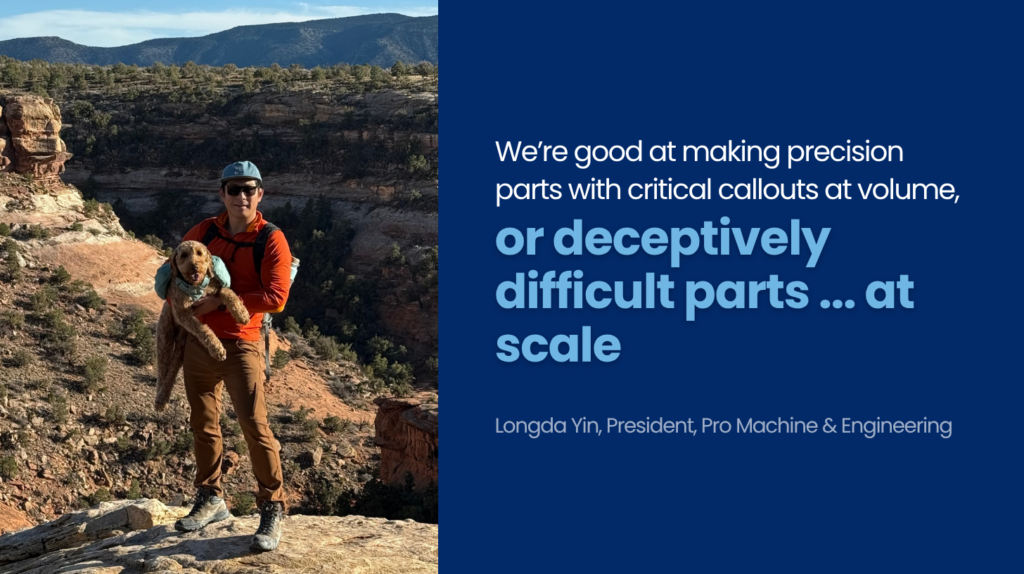
We have a lot of institutional knowledge, so being able to make precision parts with critical callouts at volume is what I would say we’re good at.
We probably can’t turn out the most low‑cost thing when tolerances don’t matter. But if you need something with certain flatness, if you need certain parallelism or concentricity or it’s got to be exactly that and you need a bunch of it, that’s where we shine.
Q: Are there specific industries Pro Machine focuses on?
We’re currently more focused on robotics and the space industries right now. We also have a small presence in BioMed and we’re looking to get into Aero.
I make the distinction between Aero and Space because they seem to be very different industries right now. I just went to the Space Symposium last week and it was impressed upon me how different they are.
Q: Your academic career started in mechanical engineering at Cornell — tell us more.
It started with my formal education. I did four years of mechanical engineering at Cornell and then I did another year of mechanical engineering to get my Masters.
It took me that long to really solidify that I did not want to do mechanical engineering at that time. So I immediately went into software.
Q: What made you walk away from engineering after earning a Master’s degree in it?
It was just really hard. I tried to do too much. I played football. I did this, I did that. I was in a really hard degree.
The weather, if you can believe it, really clouded my view of what I wanted to do. Upstate New York is just a tough place to be in the winter. It was tough. I associated that with mechanical engineering and I didn’t find joy in it at the time.
I was proud I could do it. I’m proud I have those degrees and what they represent, but I didn’t know if I wanted to keep doing that for the rest of my life.
Q: Where did that take you next?
That brought me to software, the promised land of milk and honey (laughs). Things were good and it was booming.
I did that for a while. First, starting out with a little bit of programming, then moved into Project Management Office (PMO). Then I consulted on agile software development as an Agile coach.
From there, I went into other businesses and helped with transformation – leading a PMO at another company called AIS. And thereafter, moved into insurance.
But, I always wanted to do my own thing.
When you consult, you’re constantly trying to tweak things for other people. You’re also looking at your own organization trying to tweak things. You start thinking you could do better. You feel like your boss could do this better. You feel like the company should be doing things a different way.
You get more and more critical.
I had to look myself in the mirror and say if you’re going to criticize somebody, can you do better? If you can’t do better, you should shut up. But if you can do better, maybe you should prove it.
At that time, I had accumulated enough financially that I could take a shot at it. So I decided I was going to go be a business owner and try to grow something and test whether I truly do know better or if I can cut it.
Q: Of all the industries you could have entered, why manufacturing?
I think it’s important for this country. We are not good at manufacturing right now. We’re just not. I feel like I can say that because I’m doing it. I’m in it. I make a living from it. I see it all the time. We were really awesome at it and now, we’re not good at it.
But we can get better. You have to first recognize where your deficiencies are before you can improve.
Robotics, for example, lags artificial intelligence. From a job security perspective we’re still going to need physical things. We’re physical beings.
We need help in the United States. I care about pushing and making it better. I also think it’s hard to make a living in manufacturing and I care about making manufacturing a place where people can make a living.
The wages haven’t really changed from 30 years ago to now. It’s difficult to feel proud of being in manufacturing and difficult to have a good livelihood. I wanted to see if we could do something about that and make Pro Machine a good place to work.
Q: From someone who’s in it daily now, what’s your take on how U.S. manufacturing lost its edge?
I think it’s because we just don’t do it a lot anymore. If you don’t do something a lot, you’re not as good at it.
We also don’t invest in it as much. A long time ago, you had a $50 American product and maybe a $20 Chinese product. It was a trade‑off. If you wanted something really nice, you bought the $50 American product. If you wanted a budget option, you bought the $20 Chinese product.
People still think that’s the case. It’s not true anymore. Now the $20 Chinese product is as good as the $50 American product. They’ve been doing it for so long that they keep getting better and better, while we struggle to improve.
We also don’t know how to make a usable $20 product. We don’t know how to cut corners and make something fast and cheap when that is what’s required. That’s a skill.
I think not understanding where we are and not funding that contributes to the issue.
Personally, it’s also a touchy subject because people see my name and they wonder about my intentions. I came here when I was two. I’m naturalized. I care about this place. I’m putting time and energy into developing manufacturing in the United States.
Q: Buying a business sounds straightforward until it isn’t. What caught you off guard?
Buying a business has no clear structure. In real estate there is a process. You put it under contract, earnest money, inspection, negotiate, and close.
When you’re buying a business it’s like nobody knows what the process is. Do you do an asset sale or a stock sale? What are the tax implications? These are big decisions and not everybody understands them. Sometimes, people feel like they have to pretend they know the answers when they don’t.
If you make the wrong choice you can end up realizing later that you should have structured the deal differently. I’m honestly surprised that small business ownership is so prevalent in the United States and yet there isn’t a better template for buying a business.
Q: What did the first chapter of ownership actually feel like from the inside?
You have to keep the flywheel spinning in terms of incoming work. If you let off the gas even a little bit, you feel that for a long time.
Transitioning that between the old owner and the new owner is also really important. Getting the engine started again requires a lot of energy and money. It feels like the hardest workout of your life.
For six months it felt like that: constantly tweaking operations, improving systems, paying bills, and trying to keep momentum.
Q: You’re two years in now, where does your attention go on a daily basis?
Operations and quality.
We’re working on building quality into everything we do so it’s non‑negotiable. Any hiccups are incredibly costly. Running a business is like running a marathon. You need a rhythm. If you sprint, stop, and start again constantly, it’s exhausting.
Q: Did your background is in software and agile change how you saw the shop?
I saw an opportunity in keeping the sales pipeline strong, structuring work like agile teams, creating small autonomous teams that can complete work.
Another opportunity was cultural. Manufacturing has this old stereotype of yelling at people and just grinding through work. I don’t think that’s necessary. People respect leadership without yelling. If someone doesn’t listen after you’ve communicated clearly, then you address the problem or part ways.
Q: Culture change in a machine shop is no small thing — how are you actually doing it?
I try to lead by example. We run retrospectives where the team talks about what went well and what could be improved. The focus is corrective, not accusatory. That transparency helps people talk about problems without being confrontational.
I also emphasize metrics. Measurement changes behavior. You need to measure the things that actually guide behavior instead of measuring everything. We’re selective about our key performance indicators.
Q: Can you give us a sense of the kind of work that comes through your shop?
We make some really cool parts for different industries. A good example is this small component for heart surgery. It’s a sizer used for a triple bypass. It’s basically used as a gauge. It’s like making a ruler. You take for granted that the ruler is one inch or two inches, but how did they make that ruler?
There’s a whole process behind it. The doctor uses this gauge to figure out what size stent to put in your heart. It’s made out of Nitinol, so you can bend it in all sorts of shapes and it straightens out. It’s just a really cool thing.
There’s also a part used on some of the coolest fighter aircraft you can think of. It looks like a tiny set screw, but it has a lot of complex features. It’s extremely important and very expensive.
There is one guy in my shop who makes it. His name is Sunny. People call us asking specifically for him because they know he can make that part. The same goes for some of my other machinists, like Chuck.
They have knowledge and skill that exists mostly in their heads. I’m proud of them but also terrified that the knowledge could disappear when they retire.
Q: That’s a real vulnerability. What are you doing to make sure that knowledge doesn’t walk out the door?
The first step is digitizing everything. Machinists are incredibly skilled, but many of them didn’t grow up using digital documentation systems. We need processes documented digitally and organized so others can learn from them.
The second step is making time for it. You have to be profitable enough to create the margin and time required to document knowledge.
Q: What’s the one thing most customers get wrong about working with a machine shop?
First, don’t come to me with one part (laughs). It’s not in the economics of a machine shop to make one custom part cheaply. You’re going to be upset about the price.
Second, understand how hard we are trying to get better at making your parts. When customers build long‑term relationships with machine shops, those shops become extremely efficient at making their parts. Fixtures get optimized, workflows improve, and production becomes ultra competitive. But that only happens if the relationship lasts long enough for the improvements to compound.
Q: Who’s your ideal customer. Paint us a picture.
If you have parts with critical dimensions and you need a lot of them, that’s where we’re good. Simply put: deceptively difficult parts. They don’t have a lot of features but they have tight tolerances or unique fixturing requirements.
Deceptively difficult parts at scale.
Q: Last question: What do you want to leave the manufacturing community with?
I think we need to talk to each other more. If you look at the demand for manufacturing in the United States and compare it to our actual manufacturing capability, it’s mismatched. We have more demand than supply. Somehow we’re messing up the distribution of work.
If we could collaborate more and share ideas about operations, technology, and processes, we could collectively improve. There’s room for everyone.
And we need to treat employees better so the next generation actually wants to stay in manufacturing.
If we do that, manufacturing in the United States can become stronger again.
Pro Machine and Engineering is an American-owned precision manufacturing company based in Colorado Springs, CO. Staffed to move efficiently from concept to finished part, they keep quality high and lead times tight. ITAR registered and AS9100/ISO 9001 compliant.
Learn more about Pro Machine & Engineering, or reach out to Longda Yin on Linkedin if your business is need of “deceptively difficult parts”.