Transformance Advisors on Signs You Need Lean (and how to start free)
Is your team stuck firefighting instead of actually growing? Boulder-based Transformance Advisors joined COMP to discuss Lean transformation and how they help small and mid-sized manufacturers grow through the growing pains.
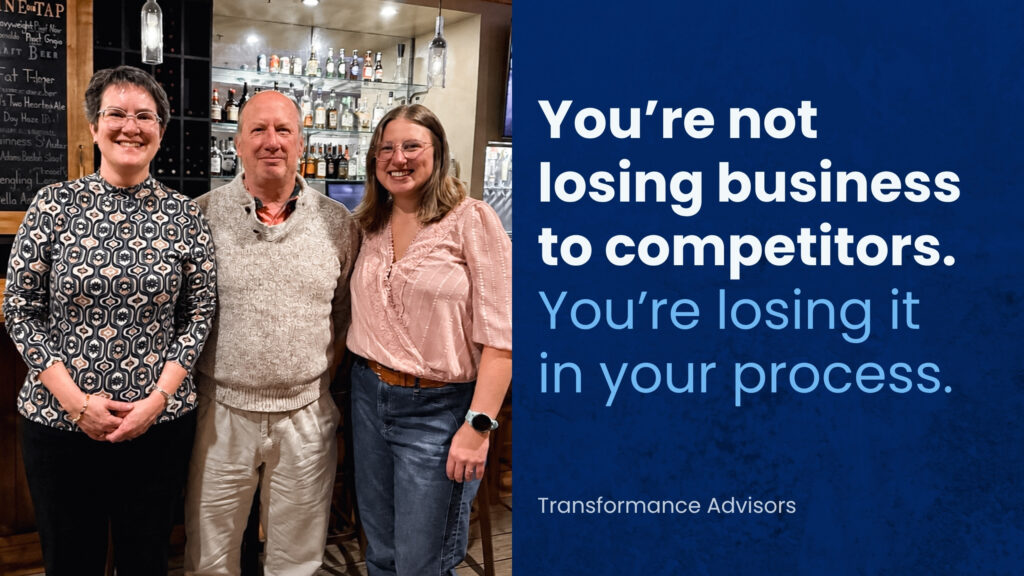
CEO and Founder Mike Loughrin, together with Vice President Lale Lovell and Director of Marketing Mara Irons, shared their personal journeys on the transformative power of Lean methodologies. Dive into the insights, success stories, and actionable advice for manufacturers ready to streamline, improve efficiency, and build continuous improvement — including free grant funding available in Colorado.
Q: Can you introduce yourself and the company?
Mike Loughrin: I have a history in organizational process improvement. I led a big process improvement project at a company I worked at. We had 16 plants in the United States, and I got to travel to all sorts of plants, small ones, big ones, and huge ones.
At Transformance Advisors, our Lean Transformation program is built for today’s challenges and includes 3 critical components: Lean projects, continuous improvement, and program management. We view Lean projects as the best way to achieve high-value improvements that build stable processes. These stable processes are then ready to leverage continuous improvement. And the last part, program management, is about designing a strategy and selecting the right improvement projects.
We offer hybrid Lean programs that combine online learning tools with in-person coaching for many customers in Colorado. The program is also available completely online. We partner with several universities to bring our online certification programs to thousands across the United States.
Q: What was your first introduction to Lean?
Mike Loughrin: The company I worked for had a relatively new president who pulled us in after he had worked for about 90 days. During an all-hands meeting, he announced we were going to do this “Lean Transformation” thing because customers were demanding better service, faster response, and other things like that.
From that, I went back to my desk and thought, “Well, that sounds interesting. I hope they have a good time.” Then, a couple of minutes later, there was a knock on the door, and it was Bill, the president. He goes, “Mike, what did you think of that Lean stuff?” I said, “Bill, that’s going to be good stuff. I wish the team the best of luck.” And he said to me, “Well, I want you to leave your job and join the Lean team full-time.” That was my introduction. It was like, “Oh, wow.” It’s funny because today we teach the change management curve, which starts with shock. The first step of a big change is shock. I was literally shocked to my core that he just asked me to leave my job. I liked my job. I got to travel all over the United States, and everybody knew me at this company. Even though it was a big company, everybody knew me. Now I’ve got to leave that job to do this risky thing. When I said yes the next day, it was the best change I ever made.
Q: Was there any culminating event that led you to start Transformance Advisors, or did you always know you were going to move in that direction?
Mike Loughrin: At one point, I was looking to do more skiing. I was interviewed and hired by a small consulting company in Boulder, so I moved to Boulder. I discovered I enjoyed working for small companies and helping others.
I did a lot of improvement projects, which were more software-oriented. I had just wrapped up one of those when a colleague called me. He was with Hewlett-Packard, and they were selling industrial printers to printing companies. He said, “They’re not taking advantage of the technology. They don’t know about Lean. They’re smaller companies. Can you come in and help?” Then I got dragged back into the world of Lean, and I found that many of these other companies didn’t know the power of process improvement. At the same time, it was linked to big technology investments. They were investing in this technology and not leveraging it to turn customer orders around faster and improve their quality. They were just buying fancy equipment that looked good. HP said, “We want our customers to get more out of our printing presses than they are.” So, I helped with that, and that relaunched my return to the world of Lean. Since then, I’ve moved from one project to the next. It’s been a roller coaster ride.
Q: How would you describe Lean to someone who doesn’t know what it is?
Mike Loughrin: Lean is the top program globally, but it has various approaches. Some practitioners are in one camp, others in another.
For us, Lean has a couple of components. One is that you do projects and make significant improvements to stabilize your business processes. Either they’re not up to the challenges, or their customer service is way too low. First, stabilize your processes. Then, adopt continuous improvement since the world is constantly changing. What was good yesterday might mean your process needs to be tweaked today. If you don’t have that continuous improvement mindset, you might run a project, leave things the same for a year, and then you’re back in the same spot.
For others, Lean is just about making small improvements daily. We think Lean is much bigger than small daily improvements. We tell customers, “You’re going to run a project, which might save you $150,000.” That amount of savings might take forever to do with continuous improvement alone.
Unfortunately, we also see cases where Lean tools are simply used to cut costs and lay people off. Anybody can cut their costs to zero, but you will also cut your revenue to zero at the same time.
Lean is an organizational improvement program that needs to include everyone and should not be limited to 1 functional silo. We love to use Lean to improve overall performance, increase revenue, and manage costs.
Q: Do you find that most people who are learning about Lean or stumbling into Lean on their own know exactly what it is, or is there a learning curve when they come to Transformance Advisors?
Mara Irons: A lot of them don’t know exactly what Lean is. There are several variations of Lean and people will often have different ideas or experiences. We find it’s really helpful to start with a basic introduction to Lean to get everyone on the same page.
Q: Do you see a lot of small to midsize businesses adopting Lean?
Lale Lovell: Without a doubt, Lean works for organizations of all sizes.
For example, we recently worked with Vanlife, a custom van company in Arvada with about 20 employees. We trained the entire team in Certified Lean Apprentice, so they had a shared understanding and common vocabulary. For smaller companies, Lean is primarily about preparing for growth rather than just optimization.
Q: Did someone in their management team have experience with Lean, or did they find you because of their need to streamline?
Lale Lovell: They had gotten into understanding a bit more about the entrepreneurial operating system (EOS). They began using EOS and were exploring ways to implement operational improvements. Andy Eccles, CEO of Vanlife, researched operational improvements independently. He discovered Lean during his research and connected with Manufacturers Edge, our partner for Lean training in manufacturing through grants. They recognized that Transformance Advisors was a good fit due to our extensive Lean training program. He shared with me the video he watched on YouTube, and it was about a guy making an analogy between fixing up motorcycles and Lean. That’s what got him really interested in pursuing Lean. It was a fun story.
Q: How would a company know they need Lean?
Mara Irons: The day-to-day symptoms that signal the need for Lean typically fall into three categories: Quality of Life, Scalability, and Sustainability.
Quality of Life issues manifest as ongoing firefighting and frustration. Teams feel stretched thin, with problems recurring instead of being resolved at the root.
Scalability becomes an issue when organizations rely too heavily on a few individuals rather than strong, repeatable processes. Without empowered employees driving improvement, growth becomes difficult.
Sustainability challenges occur when leadership struggles to keep pace. Processes aren’t designed for current challenges, leaving little time for strategic focus as daily operations consume all energy.
We offer a quick self-assessment on our website called “Recognizing the Need for Lean” to help organizations identify these patterns.
Mike Loughrin: Another way to recognize the need for Lean comes from a concept called the “growth curve,” which helps us see where Lean starts paying off.
The growth curve tells us there is a big shift when an organization goes from 19 to 20 people. This is a time when processes become more important than tribal knowledge. Everything seems to break. Another phase starts when going from 34 to 35 people. This is a point where project management and processes will need more focus. Hitting 20 people and again at 35 people are points where Lean should be part of the growth equation.
Thus, a 25-person shop is right in the area where growth means they should focus on processes and it’s an ideal time for Lean.
And that’s a perfect spot for many, just after a small amount of growth. I even worked with one company where the general manager told me he purposely shrunk the company back to a level where work was fun. We help people stabilize their processes so they can take on new customers and grow their business.
Q: What is the number one reason manufacturers come to Transformance Advisors?
Lale Lovell: The number one reason people come to TA is to improve the quality of life and work experience. A very close second, though, is creating more predictability so they can grow revenue. We emphasize how Lean can improve the quality of work-life by reducing firefighting and frustration. Many are frustrated with inefficient processes and firefighting, seeking a different approach to work. That’s one of the key reasons people come to us.
We also offer a setup that’s a bit different from some of the other training companies. We really emphasize learning by doing. A big element of our training is an improvement project. Participants in our Practitioner course actively engage in a value stream mapping project, with coaching to guide their Lean implementation. It’s very hands-on. It’s very applicable right out of the gate. You don’t spend a whole bunch of time learning material and then have to figure out how it applies to your company. We really integrate that application with the course.
Q: Is there an exercise that you walk manufacturers through where you help them prioritize their projects, or do they come with a project already in place?
Lale Lovell: In the first week, we conduct a waste walk with our new clients. We walk through the facility to identify waste, discuss its types, and brainstorm potential projects. Before developing the project charter, we hold a brainstorming session on the organization’s value streams. This approach helps people identify meaningful projects to pursue.
Q: What are the options companies/customers have to begin their Lean journey?
Lale Lovell: We typically offer an introductory, Apprentice-level group training session tailored to each company. During class time, we focus on simulations and interactive engagements to help participants practice the material.
From there, we usually recommend a subset of people, such as the leadership team and process owners, take the longer Certified Lean Practitioner course. This course includes a value stream mapping project. We offer in-person, online, or hybrid options depending on the company’s culture.
Q: How is the pacing handled so people don’t fall behind after the first week?
Mike Loughrin: It does happen sometimes. People want to implement everything immediately. It can seem overwhelming at first. This is why we have scheduled breaks to work on projects between teaching sessions. This helps clarify priorities and keeps momentum. Having space and time, along with guidance and accountability, makes a difference. Anyone working on a project might get frustrated and set it aside for a month, but maintaining a scheduled rhythm helps prevent this delay.
Andy from Vanlife told us that when we did the Certified Lean Apprentice course with his whole company, the shop floor was cleaned up and organized before we returned to start the Certified Lean Practitioner course the next week. Everything looked great. I said, “Wow, this is awesome.” He mentioned that people felt they had been given permission to take action. This was an unexpected benefit of the training. By having leadership also take the training, you’re effectively saying, “I want you to do all this,” which encourages people to take initiative. It’s also helping spark a cultural shift.
Q: Can you tell me about the different phases or levels of certification?
Mike Loughrin: Our classes were developed in collaboration with our customers to meet their needs. We train everyone to be team members and work with select individuals who will be charged with leading improvement projects.
There are 4 levels of certification:
- The Lean Apprentice course provides the basics about Lean and waste elimination, essential for everyone.
- The Lean Practitioner course prepares current or future leaders to manage significant projects, with Lean Apprentice participants supporting their teams.
- The Lean Expert course focuses on solving complex problems that require root cause analysis to find the elusive root cause.
- The Lean Master class covers leadership responsibilities, project selection, and program assessment, emphasizing the importance of integrating the Lean Transformation program throughout an organization.
Our package of certifications supports getting everyone engaged and empowered to help with waste elimination. It aligns with what our customers have asked for.
Q: What is the typical timeframe for someone to go through the training courses of Lean with Transformance Advisors?
Lale Lovell: The training typically involves three one-week engagements, with at least a week or two break between them. That’s the general timeframe. The Lean Practitioner course includes a value stream mapping project that teams work on in-between training sessions.
A hybrid approach allows more sessions to be conducted off-site, reducing the overall time commitment. These projects can generate significant savings, often $150,000 to $200,000.
Participants are typically managers, supervisors, and project leaders responsible for process improvements. They work on improving their own processes while continuing their regular responsibilities.
Q: If someone did each of these courses starting one after the other, how long would it take?
Lale Lovell: The Lean Apprentice course is completed in one day. The Lean Practitioner course takes about three weeks, which can be scheduled flexibly over two months.
The problem-solving course lasts approximately two months. If they move quickly, they can complete all courses within six months with the right team. Our hybrid approach and online tools allow for flexible training, including new hires at any time.
In six months, a company can establish a training program, complete several value stream projects, and solve complex problems. This training quickly translates into tangible benefits, making it a worthwhile investment.
Q: Do you have examples of customers where Lean resulted in a lot of great benefits?
Mike Loughrin: I recall a Colorado company we worked with called Mount Sopris. They redesigned their processes and then adopted continuous improvement. About six months later, I met with the operations manager, who was thrilled with the ongoing improvements. They didn’t simply implement one-time changes and stop. They were committed to continuous improvement, and they kept pushing forward.
Another example is Cabela’s. They overhauled their onboarding process for new hires, which had become slow and expensive. They came to our annual alumni event to share their story with others. They reported how the savings from just one Lean project were astonishing. HR was also committed to ongoing improvements, and they had continued to build on the initial success.
Q: Can you talk about outcomes you’ve seen when implementing Lean that have transpired into a growth strategy?
Lale Lovell: During our initial waste walk, we often zero in on areas with growth opportunities. Long customer order cycles are a place where revenue can easily grow if cycle times can be reduced. In some cases, quality rejects often cause lost revenue. One company was sold out, and each reduction in a quality reject lead directly to more revenue. Another company was losing business because of long changeover times that resulted in them not being able to make delivery date promises. And no promise on delivery means no order received. The last one I recall is a company that had a product line that was all tribal knowledge without standardized processes. This product line had significant revenue growth potential if only it could be reliably and repeatedly used in the same way.
Q: Your program is hybrid and online, and not boots-on-the-ground consulting in the traditional sense. How do you coach culture change and floor-level transformation through a screen?
Lale Lovell: We are onsite for the highest value training items and coaching of the key project work. The online components let people learn at their own pace without requiring attendance at training classes.
The culture change happens through the process of running a Lean project. We mentioned that everyone gets foundational training and is then part of the improvement project. It’s how you run a project that changes the culture. It happens when people are successful and their ideas are part of the solution.
The culture will also change as people move to continuous improvement after a process has been stabilized.
Our competition will often push people to do easy-sounding improvements which don’t take root. Starting with workplace organization efforts (5S) sounds easy to do, but they tend to not be sustained if people don’t embrace a Lean culture. So, we shy away from doing that as a quick win at the beginning of an engagement.
Our approach helps the team build confidence and skills to lead improvement projects and sustain continuous improvement.
Q: Do people in Colorado prefer on-site or online?
Mike Loughrin: Recently, we’ve seen an uptick in in-person training. Online training, while effective, can be more challenging when managing projects and deadlines remotely.
Some companies prefer online training and find it effective. We are there for support and to provide nudges when people fall behind.
However, we’ve found that people in Colorado like the hybrid approach. They can take online training in small bites, and we’re on-site for much of the project work and hitting the milestones.
Q: You talk about the “Project Champion” as a critical and often overlooked role. Who is that person usually, and what happens to a Lean program when that role isn’t filled correctly?
Lale Lovell: For smaller organizations, the champion is often the CEO, COO, or VP role.
If the project champion role isn’t taken seriously, people won’t be given time or support to make the improvements, projects will flounder, and the Lean initiative will fail. People need to see that the leaders of the company are invested in the Lean program for it to be successful.
The leader should aim to champion several projects, which could collectively be highly valuable. We provide more information and help for this critical role on the Lean Leadership page on our website.
Q: If a customer wants to try you out, what is the path of least resistance to get their foot in the Lean door?
Mara Irons: First, see if they qualify for a training grant. Our relationship with Manufacturer’s Edge has allowed us to expand both our reach and impact. Training grants support our hybrid model, combining online learning with in-person coaching and project work.
That’s where a lot of our great engagements with Colorado companies have been coming from lately, the Skill Advance Colorado Job Training Grants that Manufacturer’s Edge can administer.
Alternatively, if they prefer a smaller approach, they can have one person take our online courses and contact us for more details. But we feel like the grant is a great tool because it will enable you to train your whole company. If you’re a small to medium-sized business, that’s the real power of Lean: getting everyone to have that same body of knowledge and vocabulary to help really drive continuous improvement.
Q: What would be an ideal next step for anyone interested in your training programs?
Lale Lovell: Our website has a lot of information, including articles, assessments, and other free resources. People can sign up for our newsletter for more engagement, and we’re always happy to discuss this further. If anyone wants to connect and learn more about Lean, we’re open to conversations.
Mara Irons: A good first step is to read the Recognizing the Need for Lean article and take the assessment so they can evaluate where they stand. This assessment also highlights how we’re different. We ask questions about quality of life, frustrations, and other factors.
Mike Loughrin: The next step is to review our website. We lay out our approach and how we think. We’ve tailored our approach to Colorado and want to help Colorado leaders and companies get back on the growth curve. We can schedule a call or an in-person meeting. We start by listening and want to hear what’s going wrong. Then, we’ll help you make it right.
Transformance Advisors is a Boulder, Colorado-based consulting firm specializing in Lean transformation and continuous improvement. The company helps organizations build sustainable performance through structured Lean projects, continuous improvement systems, and program management. It offers hybrid and online training, coaching, and industry-recognized certifications in Lean and Six Sigma. By combining practical education with real-world application, Transformance Advisors empowers leaders and employees to eliminate waste, improve processes, and drive measurable results across diverse industries while supporting long-term cultural change and organizational growth.
Learn more about Transformance Advisors, or connect with CEO and Founder Mike Loughrin, Vice President Lale Lovell, and Director of Marketing Mara Irons on LinkedIn.