Better Process, Better Outcomes with Ken Rayment of Better Process
How Practical Automation is Powering Colorado Manufacturing
Colorado Manufacturing Partners (COMP) exists to position Colorado as a national hub for modern manufacturing technology and growth. In this Q&A, we sat down with Ken Rayment, founder of Better Process located in Loveland, Colorado, to learn how his team is helping other companies navigate the journey to automation—addressing common pain points, overcoming barriers, and and guiding organizations through the shifts that come before and after automation is integrated.
Q: Ken, take us back to the beginning – how did Better Process actually start?
Well, Better Process actually started in my garage in 2020.
I took an early retirement right before Covid hit. Things got really quiet which gave me a good opportunity to take a step back and plan what I’m going to do with the business.
At first, it was just contract engineering work from previous employers and industry contracts I had made throughout my career in engineering.
Then in 2022, we hired our first employee and moved into The Warehouse Business Accelerator and Innovation Hub at Forge Campus in Loveland. That was really the start of our our growth and we’ve been growing phenomenally ever since. Today we’re a 12‑person team, and in the middle of moving from a 1,000‑square‑foot space into something three times the size.
It’s been just…just a real fun job. I mean, I had a fabulous career – over 40 years in manufacturing from individual contributor up to management, and this business has been the best part of my career.
Q: How did your journey in automation begin?
I got started in my automation career at Woodward. But you know, I’ll tell everybody that we are manufacturing engineers first. Automation comes just literally from our clients asking us for faster outputs and less people involvement with the boring, repetitive stuff.
And so first, we’re manufacturing engineers, and we solve manufacturing engineering challenges with that hat on, and then find automation opportunities to compliment the solution.
Q: What industries does Better Process serve? Do you focus on any niches?
Yeah, it’s a great question that we get a lot, and I have to say it’s literally the manufacturing industry, you know, small to midsize manufacturers and industries supporting anything from aerospace to medical any everything in between.
We’ve even done things for the vitamin industry: barcode reading, and that was an amazing project. It was just so much fun, and high speed because people were labeling the bottles and you had to make sure that what’s in the bottle was the right thing. We had three cameras going and it was amazing.
Q: What’s been your most memorable project so far, and how did automation drive real, measurable results?
We did an application for a company that made a medical device that was used in the eye after cataract surgery.
Typically, after cataract surgery, you get a very solid lens placed into your eye which doesn’t allow your muscles to contract making it very difficult to drive or read – so you still have to wear glasses. The company we worked with had developed a very tiny bag that allows your muscles to still contract and change focus.
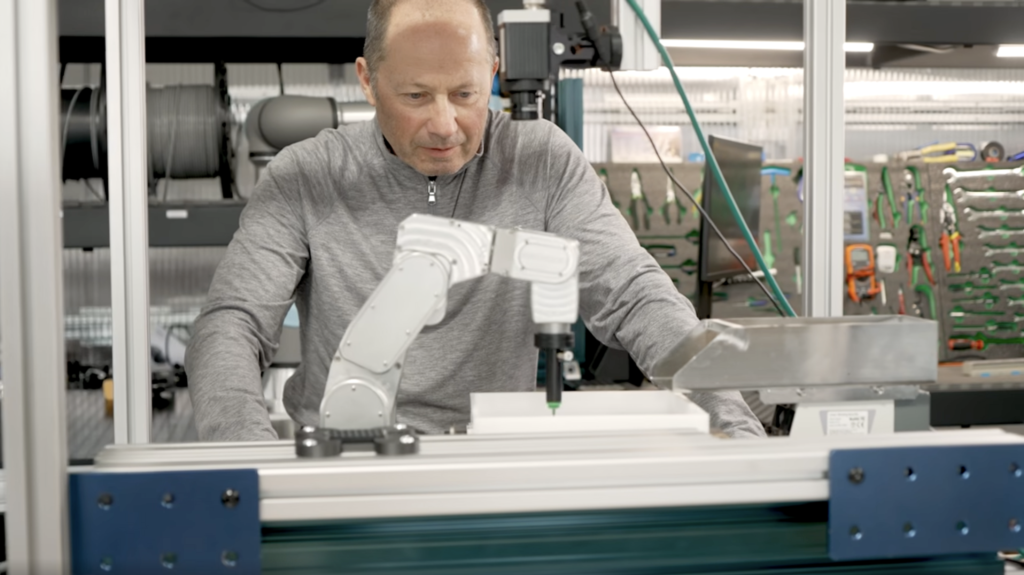
And so we created the process to automate the production of this bag using a robot, a bunch of cameras, five micron tip, tilt, turn and assembly, etc.
And it took their yield from 30 percent to over 95%.
It’s one of the one of the major projects that we’re very proud of. But it’s funny because you get personally attached to every project that you do – so I can’t say any of them are my favorite, each one is special.
Q: How do you work with companies to identify the right automation for them?
When I go to a factory and speak with the owner or with the operations manager they take me to their most painful place in the factory. They know where that is but they generally don’t know how to solve that problem. It’s almost always something that’s repetitive and they have a hard time keeping people in the chairs to do this type of work because it’s boring, monotonous.
And so what do robots do fantastically?
They do repetitive things really well – and boring things really well. Robots don’t get bored, right? And their visual acuity after lunch is the same as it is in the morning. They have that consistency that is hard for humans to maintain. And the folks that were doing those positions, they become so grateful we’ve automated that repetitious process which now frees them to go and do something that brings more value to the company in utilizing their skills.
There’s this stigma that “Oh, they’re [robots] are going to take over our jobs now.” Never have I done an implementation where somebody has lost their job.
Q: What shifts do you see in the before / after of automation being integrated inside a company?
So the first thing companies do is name the robot. If the robot isn’t named by the time I leave on the first day, I’m worried that there’s something going on (laughs).
But gradually, you start to see the folks whose work is most impacted by the automation, they’re the ones that start pushing for more: “Hey, could we do something similar over here or over there?” So the attitude does absolutely change over time when they see that there isn’t any negatives – only positive outcomes for everybody involved.
Q: What’s the best robot name you’ve heard? Boxilla (laughs), it was used to make boxes.
Q: What is the biggest barrier manufacturers typically face when adopting automation into their process?
Definitely financial. Automation tends to be big projects that are expensive. But Better Process is small, we have a team of 12 and a lot of competitors that are much larger than us so customers are not used to seeing the type of ROI we can provide. Typically, our return on investment is paid off in a couple years and so it’s quite attractive to look at it with that financial lens.
But the real question isn’t cost. It’s return.
Right now we’re working with leasing companies to shift automation projects from a CAPEX to an OPEX expense. So now instead of saying, “This is a $150,000 project,” now it’s, “Hey, can you afford $3,000 a month for five years?” That way the approval cycle is typically a lot less.
Also a lot of times your customers will help you pay for some of that automation because they see it as an investment in you, and in that same way, in themselves in order to achieve a stable supply chain. And the benefit? That investment, makes you a more embedded, long-term partner in their supply chain.
Many times I’ve heard from our customers that their customers are going to invest in their automation project. For example, let’s say you’re working with a machine tending project and you’re doing press break bending. Literally, one of the most boring and repetitive jobs known to humankind. So, you go to your client who you’re making a million widgets for and say, “We want to automate this process so that we’ve got better repeatability and on-time delivery for you.”
There could be a cost-sharing element where their customers share in the cost as an investment, or the automation cost can be built into the part price, charging slightly more per piece over time to pay back the investment.
Now, with these types of options, automation becomes very accessible to companies that didn’t think they could afford it.
Q: What would you say is Better Process’s super power?
So, this is not coming from me, but from our clients: we are honest, honest to a fault. We just have solid integrity. We’re going to make things right when they’re not right.
We’re just very in tune with the clients, their specifications and what needs to get solved in the manufacturing process. And because we deal with small and mid-size manufacturers, we are also very cost-effective. And when it comes to the ROIs that our clients see when working with us, we are just super competitive. And, I also have to say our super power is really our team.
Q: What’s been your proudest moment in the time you’ve been in business with Better Process? What would you say is Better Process’s super power?
If I look at the 12 people who are employees here, that makes me the most proud. And you know what? The majority of them come from internships. And we teach them young to really bring up the next generation of engineers. You’ve got to build your bench. I’ve always done that with my previous employers.
And you know what ends up happening? We get this fresh viewpoint, this great energy and they get a place where they’re respected and their opinion matters. And that’s everything. So even though we’re a small company, we pay out reimbursements on tuition as a benefit to attract the next generation of talent.
One of my longest employees came in as a 16-year-old from high school and she just loved to do CAD. Now she’s a sophomore at CU Boulder and she’s so far ahead of her peers.
It’s just really cool to see.
Q: If you take a step back, what do you think is the biggest painpoint or challenge for Colorado Manufacturers?
Wow, that’s such a broad question.
I think it’s just lack of awareness. I don’t know that there is an awareness of the depth of how good Colorado manufacturing really is. You hear a lot about the different industries in Colorado – but surprisingly, not much about manufacturing. You hear more about it in the Midwest, and California, Boston – all those places, but you don’t really hear about it here.
To give you an example, there’s a machine shop in Fort Collins that does work for SpaceX, Tesla—all these big-name companies. But you never hear about them. They’re making highly specialized, high-tolerance parts for some of the most critical industries out there.
And that’s what amazes me. These kinds of manufacturers are a core part of Colorado’s manufacturing ecosystem supporting much bigger national and global missions, and most people have no idea they exist.
Q: With Colorado aiming to grow as a manufacturing hub, and most manufacturers being small to mid-sized, what advice would you give them to compete and grow?
Make your decision early on whether you want to go down the personnel route or the automation route. A lot of great companies do it the hard way, continuing to go down a path of doing things “the way we’ve always done them so we’re going to continue to do them this way.”
Question that. I’m not saying that automation is always the answer, I’m just saying there could be some valuable gains and lift for you in the future: ten years or five years down the road. And it could prevent you from the headache that comes with the inevitable personnel issues because you postponed an opportunity for automation that could have circumvented it. You know what I mean? Just think about automation early enough so that investment that you make now could pay off very well down the road, and probably earlier than you thought.
Is your company looking to streamline operations and implement automation? Ken Rayment and the team at Better Process can guide you through the challenges, help you overcome common barriers, and design solutions that work for your people and processes. Get in touch today to see how your business can benefit. Get in touch with them today