
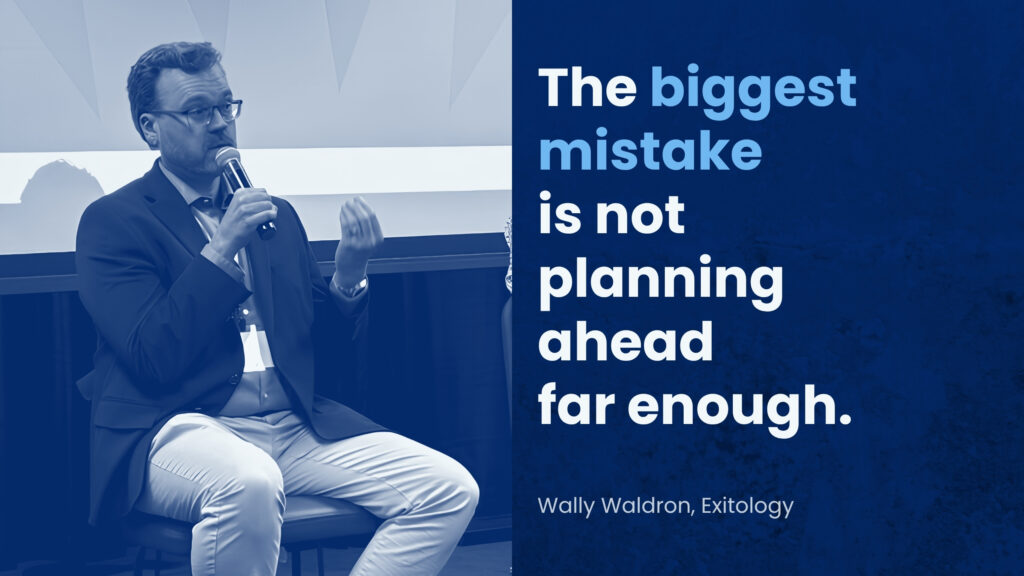
Meet Wally Waldron with Exitology
Jason “Wally” Waldron didn’t set out to build an exit readiness company – he set out to solve a problem he believed too many business owners were ignoring. Part strategist, part historian, and fully convinced that manufacturers deserve better options at the end of their life’s work, Wally built Exitology to help owners increase value, reduce risk, and prepare for an exit on their own terms. What began as a book written during the pandemic has grown into a structured process designed to help manufacturers become more transferable, more resilient, and ultimately more ready for whatever comes next.
Q: What inspired you to create Exitology?
Going back, I had been building a business that focused on business growth strategy and solving the profit gap, generating more profit, until COVID hit.
[Pre-COVID] I’d been interviewing and working with a number of manufacturers and industrial companies all up and down the supply chain. When COVID arrived, there was time to “write that book that you’ve been meaning to for the last three or four years.”
Keeping all of this in mind, I got righteously angry. There was this situation happening that clearly was bigger and more out of control than anybody else. We were entering a pandemic – it is what it is. And all of a sudden, there was a situation where some businesses were deemed essential, and other businesses that looked almost exactly the same were deemed unessential.
I wanted to have a positive place to put that energy. In doing so, the book Exitology was born. And eventually the reorganization of what our company does for people and the bigger transformations we can create for people came out of the seeds of that moment.
Q: Did you start with the book first?
Yeah, I did. I wrote the missing manual. I was thinking, if I were a frustrated, cheap and analytical manufacturing owner – could I gut it out, read this manual, and add another million dollars to my business? That was the frame of mind I wrote the book with.
A business owner who kind of fit that description saw a review copy of what I was working on and said, “Hey, if I was a some-odd-year-old manufacturing owner, I would read this book and just ask you how much money I could pay you to make all this stuff happen for me.” That’s when I knew I was on the right track.
What was interesting about it, though, is that after we wrote the book and put it out there, we discovered a much greater universe of exit planning advisors – both on the business side and the personal side.
There was this group of people deploying something called the “Value Acceleration Methodology”. I realized I had part of the book written, but there was this whole other proven methodology that I could put on the back end of what we were already doing. That allowed us to not only create bigger results but also prove the value of those results and open up a lot more exit options for the owners along the way.
Q: Tell me a little bit about your background. Who is Jason “Wally” Waldron?
I’ve always been entrepreneurial. I was ascending to run IT at an accounting firm, where I got to understand all those different angles of how businesses work.
I started getting restless and a friend of mine had raised funds from friends and family but had put the money into his personal checking account. I told him, “That’s illegal. Let’s help you create a business entity and learn how to do startup business together.”
That business is still around today. They celebrated their 20th anniversary, and I was involved in the first 10 years. It started as a family business, and it eventually sold to a former employee who is now running it. I’ve lived long enough to see it start, go through some rough patches, and then be sold to its successor.
But what I learned from that experience was how to go into a company, reset its strategy, and put it on a growth trajectory in an accelerated timeframe. I learned how to understand a business almost as well as the owner does in 48 hours or less.
Q: How would you explain Exitology to a random stranger?
I got asked that this morning, and I said, “You know all the businesses out there owned by someone who is three to five years away from wanting to retire? In most cases, that person is not going to be able to sell that business or retire from it. And that’s where we help.”
[Exitology] goes through a structured process to build value in a business and make sure that it’s more transferable and more valuable. We make sure the owner is decentralized, the business is de-risked, and the owner has the option to retire.
Q: Why wouldn’t a business be able to sell or retire? What are some of the common issues you see?
Great question. Let’s start with the statistics and then answer the question.
According to the Exit Planning Institute’s State of Owner Readiness surveys conducted over the last 10 years, if you have 40 business owners in a room and they all say they want to exit, and then you come back two years later and ask, “Who’s happy?” there will be one business owner who is both happy and satisfied on a personal level and has achieved the financial outcome they desired [in selling their business].
There are seven others who experience profound regret. They might have gotten the number they wanted financially, but they don’t know who they are outside of the business. Or, they might be happy outside the business but didn’t get the financial outcome they wanted.
And then there are 32 who never even get the chance to sell.
Q: What are the reasons behind that?
Let’s reverse-engineer what a valuable and transferable business looks like: A valuable and transferable business has best-in-class tangible capital, which means repeatable and predictable net profit. It also has best-in-class intangible capitals, which drive the multiple:
For example, Human Capital: Having the best people working for you. Social Capital: Having a great internal culture and being well-regarded externally. Client Capital: None of your clients should represent more than 20% of your business. You need a premium offer to justify a premium price. And then there’s Structural Capital: Making sure people know their roles, know if they’re winning or losing, and have a clear understanding of the company’s structure and culture.
If those things are what make a business valuable and transferable, then the opposites are the reasons businesses fail to sell. For example, I spoke to a food manufacturer recently, and they told me they were having their best year ever. I asked them why, and they said, “We just signed a client you’d recognize. They’re on the S&P 500, and they now represent 60% of our business.” I told them, “I don’t even know how to say this, but you’re in deep trouble. They own you without having bought you. That’s a problem.”
Q: When you say “exit ready,” what does that mean for a manufacturer?
Say you’ve run a manufacturing firm. Let’s pretend that it’s that proverbial Monday where you’re just not feeling it anymore.
Exit ready. There’s two levels to it. The first is the business side. If someone were to come in and write a check with enough zeros, could you realistically walk away in 30 days?
The second part is the human element. Are you, as the owner, ready to take that check and walk away? Are you personally prepared to leave the business?
Being prepared for both scenarios – that’s “Exit Ready.”
Q: What are some of the biggest mistakes business owners make when looking to exit their business?
The biggest mistake is not planning ahead far enough. In my book, Exitology: Proven Strategies to Accelerate Business Growth, 3x Your Company Value and Exit the Smart Way, I talk about the idea of beginning with the end in mind.
I was just at the Denver Exit Planning Institute this morning, and we had a tax-oriented meeting, and it was all about how many options you have if you plan ahead versus if you let it sneak up on you. So the nuanced answer, the bottom line is to plan ahead.
The biggest mistake is to not plan ahead. But let’s unpack why that happens. Number one: a lot of people think they’ll never exit. But you will – whether it’s forced or unforced.
Number two: not acknowledge what you’re up against. We all have an 80% chance over the next five years of facing one of these five D’s: Death, Disability, Disease, Disagreement, or Divorce. If a business isn’t structured to support the humans running it through these inevitable challenges, then a lot of value gets destroyed.
The bottom line is to get educated as early as possible and start making business improvements that set the stage for transferability.
Q: What are some of those business improvements?
A couple of really easy ones are pricing strategy and vendor cost reviews. In an inflationary environment like we’ve had, many businesses just need to catch up to where they ought to be.
Another big issue is not thinking in terms of a value-building mindset. You need to think about what it would take to build your business so that someone else could eventually run it without you. Even if you never get there, the kind of business you’ll build by having that mindset will be light years ahead of one that’s just focused on day-to-day operations.
Q: If a manufacturer were to come to you tomorrow, what framework would you take them through in the exit readiness process?
The first thing we would do is talk about the five stages of value maturity, which goes from one – Identify what you’re worth today and then think about what your potential could be three years from now. Then we talk about protection: protecting not just the human beings but protecting the business, protecting all the things. From there, we’d talk about actually building value. And then finally, move into harvesting value and then managing that value.
As we get toward the end of that process, we’re less and less involved because the mission is more and more accomplished. But we always emphasize the importance of not just adopting a value-building mindset but also measuring results. I like Peter Drucker’s idea: “What gets measured gets managed, and what gets managed gets improved.”
So, what are we measuring? We’re measuring transferable value: your enterprise value. Are you best-in-class, middle-of-the-road, or worst-in-class?
Q: Is this typically a three-year journey, or can it be condensed into one or two years?
It’s a loaded question in the sense that we can only meet you where you are.
If we’re just putting it up on a screen and putting a road map, it’s about a three-year journey. And there’s a lot of different reasons for that. One of them is very simple. If an acquirer is coming in to look at you, they’re going to request at least the last three years of your data.
Conversely, it often takes time to work through the design and definition of something – take culture change, for example. We’ve seen situations where we’ve redefined a culture, clearly defining what it should be versus what it was. But six months later, the real question becomes: what structure do we need to actually generate growth?
Think about a business that’s plateaued at $20 million. At the strategist level, you’re asking, “What does the accountability structure look like? What does the org chart need to look like to become a $30 million company, and to do it in alignment with this culture?” You can answer that question in an afternoon. But that doesn’t mean you’ll realize the value from it right away. You have to grow into it.
Q: Who is your ideal customer?
Looking at ownership level, it’s somebody between the age of 52 and 58 who is going from exit curious to exit serious. That’s the personal side.
If you’re looking at the business side, it’s a business that is doing between $10 to $50 million in revenue. They want to grow their revenue and then grow their enterprise value by up to 3x and exit in the next three to five years.
Q: What’s the biggest misconception manufacturers have when working with a company in the exit readiness space?
I think manufacturers are too dang smart for their own good. And I say that with all the love and honor in the world.
Manufacturers often say things like, “In an ideal world, our product would be so good that the entire market would just come to us.” To which I reply, “That’s called Apple Computer, and they still have salespeople and advertisements.”
Manufacturers are highly analytical and structured in their thinking. These are human beings who, in most cases, could apply the theory of constraints and spit out amazing things very quickly.
There comes a situation where, and again I say this with all the love and respect in the world, they’re too smart for their own good.
I think it’s important to know where your swim lane is, where your zone of genius is, and also to know that on the other side of letting go of some trust and letting these structures be built around you – you’ll have more time to have an innovation lab if that’s what you desire. Or more time to do those really fun things about running this kind of company while the business part does what it needs to do.
Q: How do you make it easy for manufacturers to partner with you in this process?
What we’ve told our clients is that this [exit readiness process] is something that happens in parallel. It’s not additive.
Yes, there will be a time-investment on the front end, especially because we’re going to have to ask you a whole lot of questions. But very rapidly, we’re going to get to know your business as well as you know it yourself, except we will learn it from our number, which is the transferable value metric.
What you can expect is that because it’s happening in parallel, we’re unburdening weights off of you. It’s not uncommon that people who work with us over that three-year period of time, will actually fall in love with their business and have a new honeymoon period they didn’t see coming.
It’s always an interesting discussion because it’s not unusual that at that point in time, they get aggressive and want to grow more, and we have to remind them of their original exit timeframe and whether or not we might have to re-envision what that looks like. It’s not up to us to do that. It’s up to us to help them re-envision that and help them get there.
But it’s very important because it’s always the, “Well, I’m already so dang busy.” In my book Exitology, we talk about the difference between the gold miner and the gold miller.
The gold miner is that person who’s just too dang busy to take a moment and pause and zoom out. They’re just pounding harder for three more feet until they find that next piece of gold.
The gold miller, up in Idaho Springs, Colorado, back in the day, zoomed out and said, “There are 108 gold mines, and they’re all getting flooded. What if I drilled a single tunnel and drained 108 gold mines and put the Argo gold mill at the end of that? We could take all of the material, uplevel it, and create more value out of that material.”
Long story short, there’s still a Denver mint right down the road from that. That’s generational, significant wealth. That’s in contrast to, you know, there’s no more North Carolina Mint, no more Nevada Mint.
If you find yourself being a gold miner too much, take a breath, zoom out, go to the other side of the mountain, and look at the big picture. That’s what we’re really inviting people to do as that first step.
Q: What are some measurable outcomes manufacturers experience when partnering with Exitology versus doing this on their own?
If we get all the client success conditions right and everything goes the way it’s supposed to, you can expect to grow up to 33%, add $10 million of enterprise value, and exit on your own terms in as few as three years.
Q: For those who are new to understanding your business, you prepare manufacturers for exit readiness, but you don’t broker the deal, correct?
Correct. We advocate for your perfect exit. We want to do an Exit Options Analysis that aligns with your exit thesis and what you want out of your life’s work.
The forgotten man and woman — these people have taken on, in my opinion, far more risk than the reward they’re seeing today. I want to see these creators of wealth, these creators of value, the entrepreneurial spirit of small business America, make it to the other side. I want the original founders, owners, and second and third generations to be rewarded, but I also want to see the next owners of that business rewarded too.
If we can do all of that, then this creates a prosperity cycle where every good manufacturing job creates three great jobs in your community. Colorado can become a leader in manufacturing, which is what Colorado Manufacturing Partners is desiring.
Q: Can you share your best exit story or lesson from your time in this space?
The best exit story I have involves a company that started outside of Fort Collins in a shack in 2014. They called me in May of 2022, looking for growth strategies.
We struck a deal and started working together in June 2022, executing the plan in late August. Initially, they thought they had an 18-month exit timeframe, but we found a path where they could invest $18,000 a month and put $1.2 million of transferable value into their pocket every single month.
The owners ended up doing a slightly smaller deal, but what we thought would take 18-months actually took just four and a half months. By the end of 2022, a 35-year-old mom was financially free to spend time with her young children, and the dad got a huge paycheck and the opportunity to run his innovation lab.
The business, which was operating at $12.5 million in revenue, had the capacity to reach $25 million. The new owners that came in were able to take over and continue growing it.
The key lesson from this story is that readiness matters. The marketplace was in a perfect spot for them. You have to be ready at all times because you never know when market conditions will change. For example, Silicon Valley Bank crashed in March 2023, ending exit opportunities for some businesses for the next five or six years.
Q: What advice would you give to a manufacturing company that’s five to seven years away from exiting but feels like they don’t have the time, resources, or money to prepare?
I’d say, “You sound like every single manufacturer I’ve ever spoken to.”
It’s a choice. You can choose to take a pause, zoom out, and go on this journey. But if you choose not to, the odds are drastically stacked against you ever having the option to retire, let alone achieving your perfect exit.
I would just ask people to go into this with their eyes wide open and be reality-based.
Q: Is there a “try before you buy” option for manufacturers who want to learn more about Exitology before committing to the exit readiness process?
Of course. We’re educational first.
We have a podcast with over 60 hours of content, including case studies, interviews with subject matter experts, and conceptual discussions. We’ve also been interviewed on other industry podcasts.
There’s the book Exitology, which is available on Amazon. My favorite part of writing the book was reconnecting with all the lessons I’ve learned in business and putting them into a product.
We also regularly hold free executive briefings. These are one-hour facilitated training sessions where we walk through how to avoid getting trapped in your business and what to do about it. If you attend one of these trainings, we’ll take you through an executive debriefing and provide high-level estimates of business value.
Additionally, we host business owner roundtables, which are all-day facilitated sessions. Attendees walk away with actionable items to implement, and we check in with them after 90 days to see how they’re progressing.
Exitology works with owners of privately held manufacturing, industrial services, and supply chain businesses to grow from profits, increase business value, and exit on their own terms. Learn more at exitology.com or to further the discussion, connect with Wally on Linkedin.
If this conversation sparked new ideas for your own journey, there’s more to explore. You can dive deeper into the insights shared here through the Exitology: Unlock Your Profits, Unlock Your Potential podcast library, or explore the practical strategies in Exitology: Proven Strategies to Accelerate Business Growth, 3x Your Company Value and Exit the Smart Way by Jason “Wally” Waldron.