Chris Fagnant: The Manufacturing Leader Turned Broker Everyone Knows (Even If You Don’t Yet)
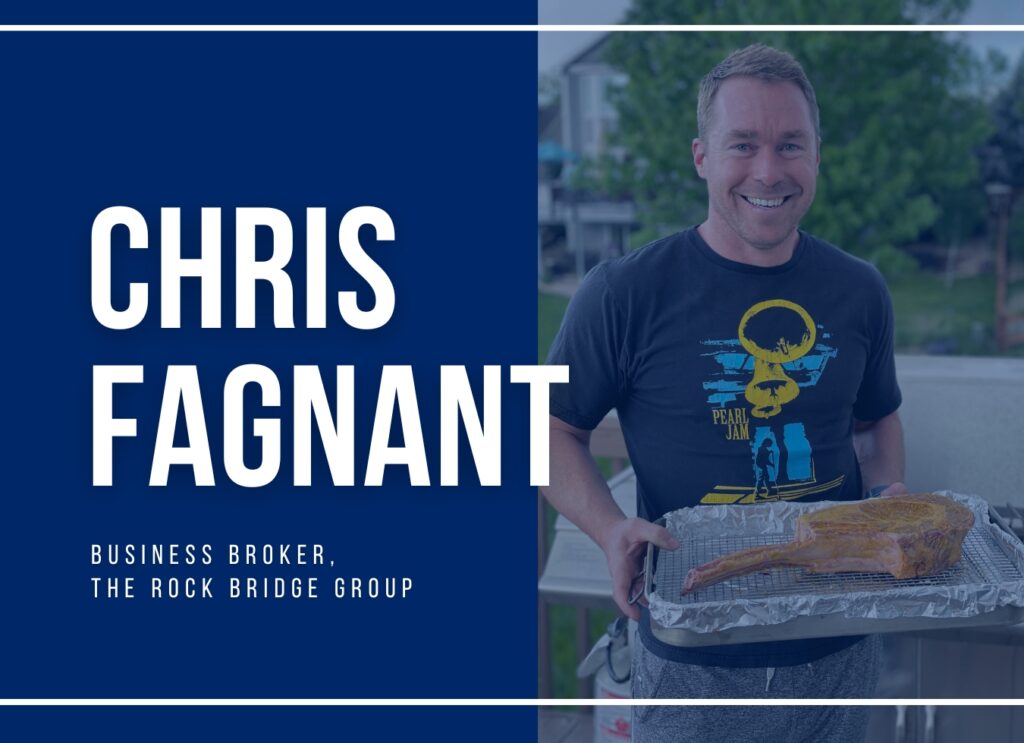
Chris Fagnant didn’t choose manufacturing — it chose him. Some might even say Chris Fagnant is manufacturing. The Colorado manufacturing community may seem quiet to outsiders, but once you’re in – it’s pretty difficult to navigate this ecosystem without hearing Chris’s name in some capacity. You either know him, know of him, and if neither, there is good reason why you should. Today, as a Broker at The Rock Bridge Group, Chris Fagnant is turning decades of hard-won experience into a competitive advantage that can be put to work for you.
Q: Let’s start from the beginning. How did manufacturing find you?
I was born into it. My grandfather on my mom’s side started a manufacturing company — making the label you peel off of yogurt or sour cream. He started it with his brother, out of a garage in Franklin Park, Illinois. What I believe to be the worst piece of real estate in America. It was inside of like a triangle — railroad on one side, end of an airport on another. You could literally pull up to work, get caught by the train, and be an hour late. But it was cheap for him. Polish grandfather — [he was] very cheap (laughs).
Q: What’s your earliest memory of actually being inside the factory as a kid?
When I was a kid, we (my parents, aunts and uncles) moved the company up to Kenosha, Wisconsin — a brand new building, beautiful — and it’s still there today. That was the company I grew up in as a kid. Worked there for cash to buy my first bike cleaning ink off the floor underneath the printing presses, among other jobs they couldn’t ever actually pay somebody to do legally. I worked in the warehouse with Robert, who was a close family friend. He would let me hop on the forklift and do all the fun stuff when my dad wasn’t looking, and then make it look like I was doing hard work when my dad came out. Both my parents worked there for I think 14 years.
Q: How did your family end up at Qualtek in Colorado Springs?
My dad is from Wyoming. My mom had grown up in Franklin Park [Chicago] but both of them kind of wanted to come west and Colorado, in general, was a target of theirs. My parents hired a broker, Ron Chernak, who started The FBB Group, to find them a business. And in July of 2000 closed on acquiring Qualtek Manufacturing. And full circle, that’s actually how I would end up at the Rock Bridge Group.
Qualtek was a mashup of a few companies that had existed in Colorado Springs for a long time. It was largely supporting the industrial infrastructure there through metal stamping, tool and die, heat treating, powder coat painting and metal finishing. When we bought the company, there were somewhere between 23 and 30 employees, doing about two and a half million dollars in sales. And one computer (laughs).
Q: One computer?!
That’s a data point my mom likes to tell people about. The first thing she did the day after they bought the company was go to Best Buy to get a new computer to replace the old one only used for data entry. There was no automation. Everything was handwritten. And this is [the year] 2000!
Q: What was the moment that changed the direction of the business?
In the early years of owning the business, we were doing passivation for these tie bands — stainless steel zip ties, essentially. Passivating them for a company out of Denver. My mom went by to drop off some parts and stopped in to introduce us as the new owners and found out they were actually thinking about going somewhere else because of delivery issues, lead times, all the rest.
And she said, ‘You know, we’re a stamping shop. We could actually stamp these parts for you.’ And it worked out because that company was buying them from Indiana, being stamped out there, shipped to Denver to get deburred, then coming to us to passivate, then going back to Denver to get packaged. So we proposed some options: A) we can inherit the tools you already own, B) we can build new ones to make the process more efficient, and C) we can take on these other processes you’re outsourcing and doing yourselves.
Over the course of a few years, we took on the entire production of that product line – from tooling and die maintenance, to stamping, deburring, passivating, packaging, labeling. And we cut what was a total production lead time measured in months down to on-demand inventory. We had parts on our shelf, they had parts on their shelf, and it was a kanban managed system.
Today, those tie bands are one of the most sophisticated zip ties in the world. They’re the grounding device for the electrical infrastructure on airplanes. There are somewhere in the neighborhood of 6,000 of them on every 737 flying in the world. At our normal run rate — in the years leading up to when we sold the company — we would make somewhere between 8 and 10 million a year.
Q: Once you proved that model worked, did you take that approach and apply it elsewhere?
Yep. The two best examples would be the medical device industry and the firearms industry. On the medical device side, we were introduced as metal stampers to a couple of guys who had invented a smarter version of a laryngoscope—the tool a nurse or doctor uses to intubate a patient. They’d invented a stainless steel version of it for strength. And because it had to be strong, but also cheap enough to be consumable, that’s where we came in.
There were technical things to overcome. We were creating a dome on a stamped part that also had flanges coming off the side, forming the metal without waves. We solved that by building a very large progressive die tooling set. If I remember correctly, it was about a 20-something stage progressive die. Twenty different forming, cutting, punching operations as the material flows through the press.
But what made it really special was our metal finishing capabilities. We had a guy named Willie Alexander — our mad scientist. He came up with a process to electropolish stainless steel, but not leave a shiny mirror polish. It was electropolished with a matte finish. That was proprietary and unique. The reason it mattered was that the device had a fiber optic light built in, and they didn’t want the light to reflect back into the doctor’s eyes. So you wanted the smooth finish, of course because it’s going in your throat, and you wanted the matte finish so it didn’t reflect and cause issues.
Q: And the firearms work?
That one connected even more dots all in one place. We were producing a series of firearm components for Ruger pistols for their factory down in Prescott, Arizona. We built the tooling, stamped the parts, deburred them, heat treated them, black oxided them, and painted them. All in-house. And I’ll never forget it — the purchasing director from Prescott came up to walk through and see how everything worked. He got to the end and said, ‘I’m going to be perfectly honest with you. When you told us you were doing this all in-house, I didn’t believe you. I can’t believe this is all happening in one place!’ We said, ‘Yep. This is real.’
Q: Was that business model you were employing, doing all these things in-house, uncommon at the time? Is that more common now across the country?
I would say yes and no. The uncommon nature of it has more to do with the history of manufacturing in the country. Metal stamping primarily has followed the automotive industry. So for the most part in the U.S., there’s a ton of stamping in the Midwest. You can still go to parts of Detroit or Milwaukee or Cleveland and see on one street — the heat treat shop, the tool and die maker, the stamper, the powder coater. All different businesses. All next to each other. They supported each other because of the volume.
In Colorado we just didn’t have that infrastructure. So we kind of had to do it ourselves. And the other reason it worked, and this is common everywhere, is that a manufacturer gets a job stamping a cell phone case cover, buys a fairly expensive machine, and it only really takes them two hours a day. So what do you use that machine for the other six? You’re selling excess capacity. We had a heat treat operation that originally was entirely job shop. Then we wrapped it into our stamping side. And we were also heat treating stamped parts for other stampers in Colorado — companies we technically competed with, but with a kind of gentlemen’s agreement. We know these aren’t our parts, so we’re not going to go after them.
Q: You’ve really grown up in Manufacturing so you have a unique perspective. How has that collaborative culture in manufacturing evolved?
Growing up, my grandpa’s generation would not tell anybody anything about what they were doing. Like, you invented this thing and somebody’s going to come steal it — and they might have. That might have been the world they lived in. My parents’ generation was a little more open, but still pretty guarded. They believed IP needed to be protected, not just legally, but like, if somebody could see what you’re doing, they would try and compete.
That started to break down, and I feel like the shift from my parents’ generation to mine opened up quite a bit — mostly because as specialization continued to happen, the likelihood that anybody was going to come in and try to do what we were doing was almost absurd. You want to invent an electro-etch process? Sure. Go for it. You’re already light years behind. You’re going to get permitting to run a phosphoric acid bath charged with 150 amps? Good luck. So there was also that realization that over time we’d become so specialized — I could encourage people to take video of a tool running and see if they could get anything out of it. You’re not going to copy this just by seeing what we do.
Q: Early on, you jumped out of manufacturing for a little while and then came back, what did that transition look like?
I came back in 2010, 2011, on the shop floor. I tried to get away from manufacturing after graduating from school and became a chef — did that for almost seven years. My parents encouraged me to go find myself. And I loved it. But I figured out pretty quickly that all I was doing was manufacturing food. I was not a top-chef artist. I was a production guy. A kitchen manager.
What brought me back was family. Our oldest daughter was born. We were living in Chicago. We realized both sets of grandparents were in Colorado. Life would be so much easier if we were close. And it was largely my parents’ retirement plan to have me take over. When I came back, I came in on the shop floor — every department. I ran our heat treat department for six months. Our heat treat shop ran somewhere between 95 and 105 degrees all year long. Heavy, oily parts. Hot, everything. And I worked in metal finishing for months at a time, working with chemistry, all suited up.
Q: After becoming President of Qualtek, was there a pivotal moment that helped shape your leadership early on?
In 2016 or 2017, we had the opportunity to hire a CEO, a friend we knew through the trade association. His name is Troy Roberts. He had started US operations for a Japanese company called Aida — making stamping presses. The stamping presses that are on the Tesla production line in Fremont, California. His factory built them, shipped them from Ohio to California. He turned that company from nothing to about $150 million a year in revenue. So yeah, that’s why we wanted to bring him in. And for me, it was an opportunity to apprentice under somebody who had just tons of industry-specific experience.
Q: What were some key learnings you took away under this ‘CEO Apprenticeship’?
One was on how we were approaching the market, figuring out what [we’re] really good at and going for it. He picked up on a capability we had called near fine blanking that eventually became a cornerstone for Qualtek. Fine blanking is a type of stamping where you stamp a part by holding both sides of it and slowly moving the die through instead of pressing until it breaks. What you get is a machined edge instead of a shear and break. We couldn’t call it fine blanking because we didn’t have a fine blank press, but we were mimicking the outcome with our servo drive presses — slowing the press down, tightening tolerances on the punch and die. Instead of a 70/30 shear and break, we’d get a 99/1. And then we could polish off that last percent and have a machined edge on a stamped part. We were able to pitch different industries on how near fine blanking would apply to their parts that people just didn’t know it existed. You’re literally inventing the conversation, making them aware.
And also, from an operations standpoint, He [Troy] just had a really good handle on how to organize the whole organization from strategy to day-to-day stuff so that meetings were actually functional. He and I implemented our own version of EOS: the Entrepreneurial Operating System. We built EOS into the business and continued running it even after Troy was gone. Sales, finance, ops – the fundamentals of a business.
Q: Tell me how COVID unfolded for Qualtek — because it ultimately led to the end of the company as you knew it.
Going into COVID, we knew a significant percentage of our revenue went into the Boeing supply chain and aerospace in general. We actually started preparing in November 2019 before the end of the year when we first heard about COVID-19 existing in China. Before the end of 2019, we had a written report to our largest customer that said: ‘This is what we will do in the event this becomes a big problem’. So in that respect, knowing we still had three months before the world shutdown, we were pretty far ahead of it. But unfortunately, everything we put in that plan ended up happening.
One of the things I had been most proud of, after taking over from my parents, was getting our customers and our customers’ customers to maintain better levels of inventory — level loading our production so we could run parts on a very regular schedule. Coming into 2019, we were in a good spot. Well, the downside of that is we had inventory, our customer had inventory, their customer had inventory and when planes stopped flying, they stopped consuming our parts. All of a sudden there’s at least six months of inventory in the system. And our largest customer went to zero practically overnight.
Q: What did it feel like to go through this crisis? How did things end?
There was probably six months of just hair-on-fire from the middle of March through August of 2020. By September we knew what was going on with the aerospace deal. It had been inked. Simultaneously, we worked with other stamping shops (some here in Colorado) to move the medical device and firearms work, essentially selling off those parts of the business individually. By the end of October I had to start telling employees, hey, we’re winding things down. And that was the beginning of moving into a skeleton crew and having the tough conversations with customers, this is where we’re headed.
But once that was over, that was honestly the least stressful time I can remember since I started working full-time. There was a period where my dad and I were just going into the factory and cleaning stuff up, selling stuff off. There were no employees. No headaches. It was close the chapter. I would come home just covered head-to-toe in what was essentially industrial waste. Smile on my face. Because it was just like — yeah, we got something done today.
Q: How did you land at Rock Bridge Group?
Ron Chernak, the broker on the deal when my parents bought Qualtek, called me up when he found out we had sold and were shutting down. First, I think he wanted to know why I didn’t call him to help me. I told him the whole evolution of the deal process we had put together with a publicly traded company — little Qualtek, family-owned, on one side of the table; a professional M&A team from a public company on the other. The letter of intent, the negotiation, the due diligence, the purchase agreement, the transition execution.
He said, ‘Huh. Have you ever thought about doing this?’ I was like, doing what? ‘Selling businesses?’ I have not thought about that one time in my life, Ron. I assumed I would run a manufacturing company for the rest of my life. And then over a few meetings, he and Rob Amarine, the current owner of Rock Bridge Group, told me more about what it was. The role they played. How Rock Bridge had been moving away from traditional business brokerage and into M&A advisory to help businesses actually get ready to sell.
That’s the thing that rang true for me. I took for granted everything our company did for years. My parents, because they came up in my mom’s family business, they knew what to do with an estate plan. They knew how to organize the entities that owned the building versus the business. They knew how to build management redundancy so that if you lose a key employee, the business doesn’t have a gap. We had an ERP system, Standard Operating Procedures connected to our quality system. You could draw a line from raw material coming in the building to a finished part leaving. I didn’t recognize how special that was because I grew up in it. How unique it was. The value of it.
Q: After owning and running a manufacturing company, what do you enjoy most about now helping other manufacturers sell theirs?
Being a broker is a way for me to put all those decades of experience to work for other people so that when they do go to sell their business, they’re getting the most for it. They’re going to get the best possible deal because they’ve done all this preparation work for years in advance of actually going to market.
And honestly, that’s the part I love — the early stages of: Hey, where are you now? What is the makeup of the business, the personality, the culture? Where do you want to be? Let’s put a plan together on how you’re going to get there. How do we bob and weave to still achieve this goal when things change along the way?
I love the introduction of buyers to sellers and being able to say, ‘This is what it looks like on paper, but here’s what you need to know. Here’s what’s under the hood. This is how the engine really works and this is why it’s unique. This is why it’s worth more than what you see on the financial statement.’ Not everybody can say that, right?
My value to a seller is that I want to be a resource. I want to understand the manufacturing factory floor operations and help them see something bespoke that they do that doesn’t show up on the financial statement, and sell that value to somebody else: This is why this company is worth buying. And also, there aren’t too many M&A advisors that can walk through a factory floor and recognize a gap in an operating system, a quality system, or a safety issue and recognize it early enough so they have the ability to fix it before it kills the deal in due diligence because everybody was ignoring it. For both the good and the bad, it’s being able to recognize it early and put a plan around how we’re going to get things where we want them so when we go to market, it’s as seamless a process as possible.
Q: What’s the real-world difference between someone who prepares the business for an exit versus someone who doesn’t?
The simplest version: from 2x to 5x. Companies are typically valued on a multiple of EBITDA: Earnings Before Interest, Tax, Depreciation, and Amortization. That multiple, whether it’s two, three, four, or five, is dependent on all those systems we’ve talked about. Good financial records — that’s good, but you’re not going to move from a 2 to a 3 just from good records. Good operating systems, quality systems, sales data that shows where leads come from and how they convert, costing data that shows how profitable each job actually is, the more of that that’s done, the higher the multiple.
If you’ve got three years to get your house in order, and you’re doing a million dollars of EBITDA — the difference between a 2x and a 5x is 3 million dollars. So the question is: How much are you willing to put in for an extra three million dollars? I love the house analogy. You’re getting ready to sell your house, you’re going to update the kitchen, do some painting, maybe add a bathroom. But you’re also going to paint in neutral colors. Not something crazy that’s you, but because you know the buyer is going to want to come in. We want you to put systems in place, but those systems need to work for them. Turnkey. The goal is to open you up to the most amount of offers, create a competitive situation, and get you maximum value.
Q: Who is the ideal business owner or company that benefits most from working with Rock Bridge?
The most obvious is the business owner looking to retire in a few years. That’s the most common. But honestly, even if you’ve got 10 years before you think you want to sell, one of the ways we work with people is just building a plan: here’s where you are today, where do you want to be, even if that’s a decade out.
At The Rock Bridge Group (formerly known as The FBB Group), specializes in the sale and acquisition of privately owned businesses throughout Colorado’s Front Range — including Denver, Colorado Springs, and surrounding markets.
To learn more about their services, visit the website, or connect with Chris on Linkedin to see how he can help you prepare for or navigate the sale of your business.