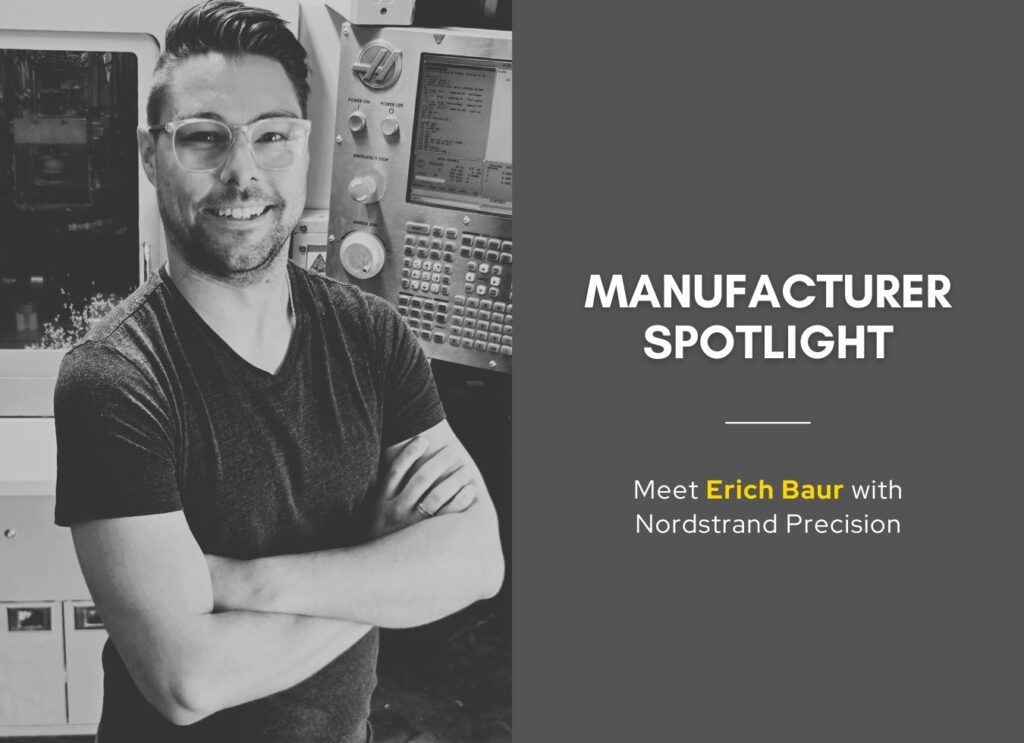
From the Shop Floor to Business Owner: Erich Baur of Nordstrand Precision
Erich Baur didn’t plan to end up in manufacturing. A mechanical engineering graduate turned Peace Corps volunteer turned shop helper, his path to founding Nordstrand Precision, LLC wound through factory floors in California, a $20 million shop build in Colorado Springs, and a year spent traveling to hundreds of machine shops across the country. What he saw along the way — and what he believes Colorado’s manufacturing scene is missing — shapes everything about the business he’s now building.
Q: Tell us who you are and introduce your new company.
My name is Erich Baur. I am a process engineer by trade, and now a business owner, who has been living in Colorado for about four years now. I just started my business last November: Nordstrand Precision, LLC, where I will be focusing on high- precision milling and machining capabilities. In short, designing, prototyping, and working with folks to make sure that their projects are realized and helping them to be successful.
Q: Where does the name Nordstrand come from?
I’m one quarter Norwegian—so it actually comes from my Norwegian ancestry. It was my family name for a long time. It’s actually my middle name as well. The Nordstrand family, five generations ago, sailed from Norway and were all cabinet makers. They were all folks who were working and building on the ship that they literally sailed from Oslo, and landed in the port of San Francisco. And that lineage is where I actually get my company’s name.
Q: Take us through the evolution of your career — from how you got into manufacturing until now.
I think it’s sort of a funny story: Like most people, I stumbled into manufacturing. After I graduated high school, I knew I wanted to be an engineer and work with my hands. But the route that I took to get to where I am now was a lot more convoluted.
I graduated with a degree in mechanical engineering in 2018, and then actually went into the Peace Corps for six months. After having some time in the Peace Corps, I realized that if I wanted to continue my engineering career — it was best for me to come back to the United States and actually start something sooner rather than later.
When I returned back to California, I started out as a shop helper for a large Fortune 500 company in Northern California: sweeping floors, cleaning machines, learning the very basics of machining. It was my first real experience into the industry after, you know, a couple of brief shop classes in college. I really fell in love with it [manufacturing] and have been growing in my knowledge base and learning ever since.
I’ve worked as a process engineer, a project manager, a supervisor, a programmer, a machinist — all sorts of different hats in the industry. And now, I get to add business owner to the list.
Q: What drew you to the Peace Corps in the first place?
I’ve always had an affinity for Spanish. Growing up in Northern California, we had a very large Mexican population — which were all of my friends growing up, but because I was the gringo who didn’t really understand a whole lot, they would always, you know, talk trash about me in Spanish (laughs).
There was something about the culture and the language I really fell in love with. So when I signed up for the Peace Corps, I was chosen to go to Guatemala to do rural extension. I was helping really small community farms with projects and outreach, like arranging logistics for them to get seeds for their communities. So it was certainly nothing related to engineering. But the communication and the soft skills — having to work with populations that you don’t readily understand — is something that certainly was in my wheelhouse and continues to help me in my career today.
I will also say that while I was in college, I was in a group called Engineers Without Borders where we got to go to Bolivia to help install latrines for a community that was just as far as you could be from anywhere else. I mean, one of the most isolated places in the world, up at like 14,000 feet. So I’ve used engineering and technical expertise to really enable communities to help better themselves.
Q: When did you know you wanted to peel off on your own and build your business?
I’ve worn a lot of hats, and I’ve seen the demand for good quality manufacturing services is very high. I especially learned that last year when I was traveling to hundreds of shops and meeting with the owners and getting to see their struggles. I kept hearing ‘we don’t have enough suppliers that we can even subcontract to.’ So I knew the demand was certainly there.
And I’ve found that folks aren’t necessarily taking advantage of all of the automation and all of the technology that we have today to really enable their workforces to be competitive in the manufacturing space.
If you go into any shop in Germany or even in Italy — there’s automation everywhere. There’s pallet changers. There’s automatic barfed saws. I mean, there’s plenty of industry. And yet, we don’t really see that as much in our local manufacturing space, for a plethora of different reasons. I think they have a different attitude there of how they train, how they onboard. And I think my goal with [Nordstrand] is to build something that’s more in the style of the European shop and really takes advantage of a lot of the cutting edge technology that you get to see at places like IMTS or at EMO.
I want to be a part of that — to not only take advantage of the technology from a business perspective, but also just because I think it’s really fun and cool.
Q: What’s the long-term vision for Nordstrand Precision?
I think the vision is really to serve the engineering and manufacturing community as a true partner. My background is really high- precision. I’ve gotten very lucky in that the first shop helper job that I had happened to be in a Fortune 100 corporate company where they had some of the nicest machine tools you can buy in the world. Experiencing that as a guy coming in and sweeping floors — to see micron level tolerances on several features and across lights-out production, that’s the world I really want to return to. My value proposition is quick turnaround, good at prototyping, but really with a high-precision focus.
When I started to soft launch this idea of having my own business, I’ve had contacts that I haven’t talked with for years coming out of the woodwork being like, ‘Hey, I don’t have anybody to go to for my products.’ So really, my vision is to grow and expand into complicated machining — like 5-axis or 13- axis mill-turn machines. Very complex stuff, definitely more difficult, challenging parts — but also to serve as a realistic partner for price while not having to sacrifice in other areas. And I think emboldening a workforce that really can support that, with a savvy maintenance team, and savvy engineers that are free to go explore and understand these new technologies and bring them in house. That’s really the five-to-ten-year vision of where I would like to be.
Q: What does an ideal customer look like for you right now, at this stage of your business?
I think a great customer for me is someone who will partner with me as I grow and expand. If you need, quick turnaround prototyping, ideally fairly precise — I would say probably not into the micron level range, but maybe into the couple thousandths — is certainly within my wheelhouse to take. Folks that want to grow can hand me small batch production runs. That, at this time, is my most ideal customer.
Q: What is your favorite part of working in manufacturing?
I think it’s having a tangible good and having tangible metrics and watching people being able to achieve those consistently. I’m a very big believer that folks want to do a good job. So when you watch folks hit something challenging — the mental reward is so, so much of a high.
Q: You seem to think differently about how manufacturing talent should be identified and developed. Can you speak to that?
I think it’s actually one of the unfortunate cultures right now within manufacturing. If you’re given a stack of a hundred resumes, you really only look at the 2% that come in that have that exact experience. This is because there is a lack of training resources and a lack of documentation on the organization’s part to train up resources to be able to do those jobs. I’ve met plenty of folks who have a fantastic work ethic that were denied opportunities because they didn’t have some certification. And vice versa, I’ve also met plenty of folks who have a certification like an engineering degree who have no business being in a shop, have no passion or desire to understand more of the underlying mechanics.
The way in which this industry chooses its talent for something like a trade really needs to be revisited. And that’s kind of also what I plan to do — having more comprehensive resources. There’s been several YouTube channels like Titans of CNC that have tried to tackle it from a national, more social media front, which I think works to some extent, but really it has to be homegrown and it has to be genuine. And I think that’s a key component of what this industry is missing — it complains so much about not having talent coming in. It’s like, well, you’re not really providing an environment where folks are truly learning, or maybe have an end goal where their learning actually gets them a direct return on their effort to do so. I think that’s just the economics with this kind of work.
Q: What was the scariest part of making the jump into business ownership?
I don’t know if anything necessarily held me back. I mean, there’s certainly a financial strain because as I’m doing this business, I’m not doing any other side jobs. I am fully my own business as of right now. And I have some orders coming in, which is great, but I was fully prepared to be like, okay, I have to go bartend on the side to help supplement this. And I think that kind of lack of financial security was a little scary. But I also am a big fan of ‘if you build it, they will come.’
In that, I’m trying to build an environment where I’m available full time to work on this. I’m working weekends to dedicate all of my resources and time to make this happen, to create systems that are scalable that I can then use and not have to totally redo once I have some more contracts coming in. So I think in that, the scariness was really honestly realizing that this is the thing I have to do now. Once you’re so sure about something, those dreams do become scary. If you’re not scared of the dreams that you have, then you’re not really dreaming big enough, I guess, is the way I would phrase it. And maybe that scariness is actually a good affirmation that this is the right path that I’ve chosen.
Q: When you look at Colorado’s manufacturing landscape, where do you see the gaps?
I worked in machine tool sales almost all of last year, and the thing I was selling was a very expensive but very high- precision piece of equipment. And I’ve worked in California and I got to see the East Coast and Midwest, and there’s so much more niche technology in these states that have more developed manufacturing scenes, where if you’re just the standard job shop that hasn’t embraced any level of automation in those states, you are totally shut out of the business. That does force an environment where you can’t just have three key customers that you’ve had for 30 years and anticipate that that’s going to sustain your business. You have to evolve and adapt.
And I think what I saw was a lot of shops running manual machines and outdated processes. And nothing wrong with that if you’re in the right market for it. But a lot of this type of business I’ve specifically seen in Colorado—there’s a lack of environments that really support the advancement of their own technology. There are OEMs that are very deliberate in saying that even though we’re located here, we source our stuff out — not even just out of state, but also out of country — because we can’t find the work locally here. And what’s funny is that those companies will pay a bunch of money in shipping costs and in tariffs and in a lot of other things to not invest in manufacturing locally here.
Q: Why do you think Colorado shops are hesitant to invest in higher precision machines?
I think a part of it is — and I’m seeing this landscape change a little bit, but I think it’s a slow change — if you look at any tech school in Colorado, what kinds of machines are they running? Well, they’re running Haas because that’s all they can afford. It’s cheap. Haas has an educational program that can lend equipment. And that’s great, but they’re not running five axis controls. They’re not working with nicer CAM systems. They’re not working with the Heidenhain controls, Siemens controls — these are the things that actually exist in the industry. And that gap of software, and not just the software gap but also the hardware gap — of how do you actually train folks to come into a shop and feel like they know what they’re doing — that link is certainly missing.
And again, this is where I think it’s like, well, you could put the onus on the education system, like how Germany does, where they have an incredibly comprehensive three-year apprenticeship program after high school, if you choose to go into manufacturing. Or you could look at the fact that a lot of the shops that maybe do have that equipment don’t have the best training resources, or have some other problems that aren’t creating good enough retention for their own employees to stay and also train other resources. I think manufacturing is very much driven by systemic investment. That’s why all of the Midwest used to have a huge booming tool and die or mold and die industry — and in the 80s, when we started outsourcing that technology, now, it doesn’t exist in the same way that it did back then.
I think aerospace drives so much of Colorado. But largely, I think those defense contractors, the OEMs — they’re keeping a lot of their technology close to the chest. They’re not actually leveraging the local shops here to make their parts unless they really prove themselves. Colorado Springs is fairly isolated. There’s no united front as far as how to network and it still feels, almost very on brand for Colorado. The Wild West. Everyone’s kind of figuring their stuff out.
Q: Who do you want to partner with, and who should reach out to connect with you?
I am not restrictive at all: anybody who is curious about manufacturing all the way up to owners of shops who maybe are looking to understand what tools they should buy next. I’m happy to talk with anybody. I’m happy to talk with research and design engineers who want to understand more about their products — not even just as contracting services for my business, but more just because I like to talk and nerd out about it.
I think it’s important to understand limitations and really try to make a lot of this knowledge more well known within this industry. So anybody who would like to connect absolutely can. Let’s talk.
In terms of formal partners, I’m looking for folks who can obviously give me work and help me grow. And additionally, if there are other shops that have overflow work, or vice versa, if we can exchange where I can use their metrology or use their water jet or some of their more auxiliary equipment as I kind of get spun up here — I would be happy to network with them.
I would also love to speak with OEMs. Unfortunately, I don’t know how present they are in the scene of community, but if there are OEMs who want to kind of partner and build stuff, I’d be happy to chat with them as well. But realistically speaking, I think shops that have overflow work, or maybe aren’t sure about something, or want to just bounce a prototype off me for a relatively low cost at this point — that’s absolutely a service that I will be happy to offer.
Nordstrand Precision delivers high-accuracy machined parts backed by exceptional customer service. Specializing in precision milling, metrology, and engineering consulting, the company supports everything from single-piece prototypes to complex, long-run production. No run is too small — every project is met with the same commitment to quality, precision, and responsiveness.
To learn more about their services, visit the website, or connect with Erich on Linkedin to see how Nordstrand can support your next project.