Meet Fuss & O’Neill Manufacturing Solutions
How Jeff Craig and Tanya Perkins are helping Manufacturers keep their equipment up and running (and printing 100 dollar bills)
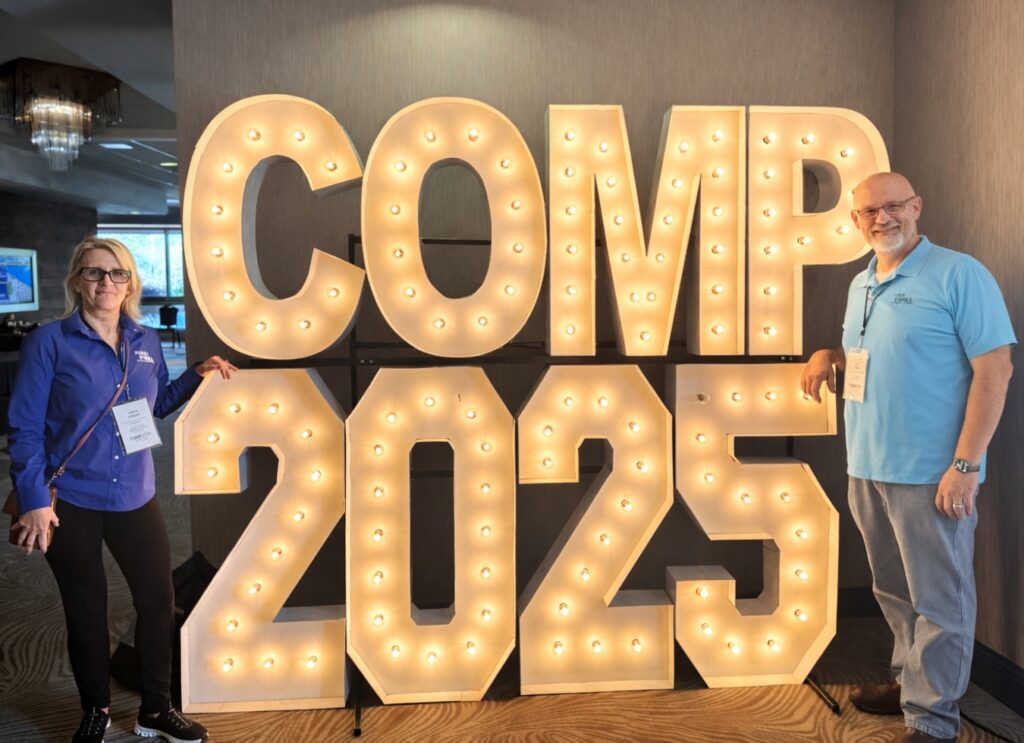
After COMP2025, Colorado Manufacturing Partners sat down with Jeff Craig, Senior
Project Manager, and Tanya Perkins, Business Development Manager at Fuss & O’Neill
Manufacturing Solutions, to dive into one of the most critical (and often frustrating) aspects of manufacturing operations: Preventative Maintenance and Equipment Protection.
Q: Alright before we dive in Jeff, tell us how you got started in the space.
Jeff: So my background is mostly military. I did 21 years in the Navy. I was a gas turbine senior chief on surface ships, engineering rooms and things like that. I retired in 2010 and went to college on my GI bill and picked up a couple of degrees. After I graduated, I got a position as a maintenance manager with a snack food factory in Killingly, Connecticut overseeing five production lines, running an entire kitchen.
That was my first exposure to manufacturing maintenance, and I realized it’s very similar to shipboard maintenance. Machinery might be a little different but the operation is still the same. You still have a process, a goal, a mission to complete. But after being there for a few years, I realized I missed the travel that I was doing in the Navy. So I started looking around and landed here at Fuss & O’Neill Manufacturing Solutions.
That was eight and a half years ago, but I’ve been involved with maintenance and machines for about 35 years.
Tanya: And for me, it’s easy to find clients for Fuss because my product is Jeff – and there’s not too many people more knowledgeable than him. So it makes it easy to put him in front of customers. Jeff just has this great dialogue with them that helps them see different perspectives.
Q: Who is Fuss & O’Neill and how can they help Colorado Manufacturers?
Jeff: Fuss & O’Neill has been around for about 100 years and has two business segments: Fuss & O’Neill the civil engineering firm, and us: Fuss & O’Neill Manufacturing Solutions.
Fuss & O’Neill Manufacturing Solutions is mostly made up of services like asset management, maintenance and reliability, improving Total Productive and Preventative Maintenance programs, OSHA mitigation, Environmental Health &Safety (EH&S), Industrial Hygiene, Machine Guarding, and Noise Sampling. You know, services geared towards facilities and manufacturers for their day-to-day operations with a goal to increase productivity and remove waste in order to get a handle on their asset management journey.
Q: What’s the primary product or service Fuss offers to manufacturers in the Manufacturing Solutions segment?
Jeff: We do a lot of workshops and trainings geared toward maintenance excellence and safety, but I also do quite a bit of direct consulting helping customers formalize maintenance programs, evaluating a company’s asset management goals, developing processes and procedures for their operations or maintenance.
Q: Is there any specific industry that Fuss is focused on?
Jeff: You know, we’re not picky on what anybody makes. That’s because the processes are all very similar. Everybody’ s running into the same heartache. So, it doesn’t matter to me what they manufacture, you know, it could be in food or defense or asphalt. It really doesn’t matter. We’re in the business of helping people.
Q: What do you see as the biggest pain companies are experiencing today when it
comes to asset care?
Jeff: It’s really the preventive maintenance process. One of the big challenges manufacturers or facilities run into is that they’ve got a “silver tsunami” happening. You know, the guys on the shop floor with that antique blonde in their beard that are getting ready to go fishing in retirement (laughs). They’re getting ready to walk out the door and take all that corporate knowledge with them. Anything that they managed to get on paper, well, it’s going to have a ton of gaps and assumptions in it.
Q: What are some of the ways Fuss & O’Neill helps bridge that transition of senior folks going out and new folks coming in?
Jeff: It’s workshops and education to get their new people up to speed. Look, there’s plenty of schools out there that have excellent tech training. They’ll teach you how to work on specific widgets and everything else, but what’s missing is how a proper asset management and maintenance plan is to be executed and managed. That’s where we come in.
Q: How long are the workshops and the training courses that Fuss offers?
Jeff: Workshops can be customizable to what the client needs. We have one-day workshops, which are very high level, up to a five-day total productive maintenance focused improvement event. So, we actually get in there and start working on equipment and start making improvements. We can even offer longer if they [customers] need it. We’ve also partnered with state manufacturing extension partnerships (MEPs) to develop a cohort of six different trainings over a six-month period.
Q: You mentioned doing workshops within cohorts. Can you expand on that?
Jeff: So there’s maintenance excellence, maintenance leadership, preventive and predictive maintenance, root cause failure analysis, planning and scheduling, and troubleshooting methodologies. In a cohort, several companies send their people to these workshops and each company will host one of the workshops at their facility.
I want operations there. I want front-end people. I want warehouse folks. I want everybody because another challenge is assuming everybody’s working together—and in traditional manufacturing, a lot of things are siloed.
Q: What does an average workshop or training look and feel like?
Jeff: We usually take two to three days depending on the training, with a group of about
25 people. The training’s are sequential. We have a set order that we put them in so each training really builds upon on another and there’s a lot of reference to the previous trainings. We talk about maintenance excellence, and barriers to good maintenance which leads into maintenance leadership. We focus on things like how to manage a maintenance organization and get them to be partners with operations instead of just enemies pointing the finger.
After preventive and predictive maintenance, we’re going to build the bones of our PMs to really work with the equipment and understand where their true points of pain are. We then look at planning and scheduling. We’re teaching teams not to respond with such knee-jerk reactions to failures. And finally, we get into root cause failure analysis.
Then, we get into troubleshooting methodologies. A lot of technicians know specific troubleshooting procedures for specific equipment, but there’s a methodology to it. There’s a mentality to it. You have to focus on instilling a troubleshooting personality for your maintenance team. If you don’t, you’re just turned into a glorified part swapper. And that can get expensive. So, we want to get away from that.
Q: Do you have options for manufacturers that can’t or don’t want to participate
through a cohort?
Jeff: Absolutely. We can do any of these workshops à la carte. For companies that don’t know where to start, we do a maintenance evaluation. I go in and I look at their organization holistically and build a report on where we think you should start…the low-hanging fruit, the quick wins.
This lets us take a look to see where you’re at now and make some recommendations – even if those recommendations don’t include us. But it will at least give you a solid approach to see where you can start building that foundation up.
Q: What are some of your favorite success stories in this industry?
Jeff: I had a lumber company up in Maine I was working with. The owner heard us speak at a Lean conference and he says, “I want every one of my employees in all three sawmills to go through total productive maintenance training. I want them to all be TPM certified.”
So, once a quarter we held a workshop for them and quickly realized that they were experiencing 39% unplanned downtime a year. I mean almost 40% of their time was due to hard equipment failures every year! And over the course of say—3 years, that 39% shrunk to less than 4%. They were really invested in making the changes and understanding how maintenance affects every part of the operation.
Tanya: We did a site visit with a previous client about 6 months prior. I asked them, “What made you guys do the training to begin with?” They’re like, “Well, our equipment kept going down. We kept having issues.” So, Jeff came in, did the 3-day maintenance excellence. And since he’s been there, they have not had a recordable downtime since.
Q: 80% of manufacturers in Colorado are considered small to mid-size businesses. What would be the best way for them to start their asset management journey?
Jeff: Well first, call Jeff Craig (laughs).
But really, I would say just get what you’re doing now [for asset management] on paper. Because everybody’s doing something when things break: You’re ordering parts when you need them. You’re cleaning up oil if it’s leaking. You know, that’s part of your asset management journey. Let’s start recording that to give a baseline of what you’re doing now.
This way we can see, okay, where’s the low-hanging fruit? If you’re spending, you know,
$10,000 a month on oil because it’s leaking out onto the floor, maybe we need to focus on fixing oil leaks. If you’re spending a ton of time with electric motors, you have to understand that operators will operate it any way they want if you don’t have a process. Or maybe SOPs are your big low-hanging fruit. How can we get them to operate the equipment correctly using those?
Just get your asset management current-state out on paper. The more detail, the better off you are. And then, that’s where we come in.
Q: What would you say to manufacturers who believe their operation is too unique for standard asset management practices?
Jeff: Uh, I would say that they are suffering from the same problems or issues that everybody else is, including their competitors.. I don’t care if they make bullets or baby bottles. It really doesn’t matter.
One of our bigger clients is a defense contractor and they are having the same problems as the mom and pop machine shop down the road. So everybody’s feeling the same pain—just in different magnitudes. I very seldom run into somebody with unique problems. No, no, no, no, no. Everybody’s having the same problems. They’re just on different scales.
Q: And what would you say to manufacturers who believe technology alone can fix broken maintenance practices?
Jeff: You know, a lot of companies say, “Well, I’m gonna get this new robotic blah blah blah.” Well, if you’re maintaining it like you did your old hunk of junk, your new robot’s going to go on strike, okay. And it’s just not going to want to work anymore.
So, you’re going to maintain it to failure pretty quickly if you’re not taking care of it the way you should. So, technology, in cases like these, is not going to fix your problem. As Albert Einstein said, “You can’t fix problems with the same thinking that caused them”. I mean, when customers really take it seriously—is when they get the best results.
Q: Are there certain situations you see that commonly lead companies to call you?
Tanya: Jeff makes the analogy like if you buy a new car, I mean, you’re going to follow
the requirements of the maintenance. You’ re going to go take it in regularly. You’re not going to skip an oil change. You’re going to protect your investment. So why would you go and invest $15 million into a piece of equipment and then not try to get everything you can out of it? It’s a waste of your investment.
So, no, we don’t want you to wait until [your equipment] goes down to call us, right? We want you to protect your investment and be proactive instead of reactive. Jeff always says when you hear your machine running—just think: that’s hundred dollar bills being printed—that’s a good thing, but when you don’t hear it running, you’re losing 100 dollar bills per minute.
Jeff’s got a great story of a food manufacturer. How much were they losing by having their equipment down on the chips they were producing in their plant per minute?
Jeff: $1,500 a minute for unplanned down time.
Tanya: A minute!
Fuss and O’Neill Manufacturing Solutions provides training that teaches, mentors, and
inspires manufacturers to develop process improvements to increase overall operational
safety, equipment reliability and to achieve the highest levels of productivity.
To learn more about their services, visit the website, or connect with Jeff or Tanya on Linkedin to see how they can help you streamline your maintenance practices and protect your most critical assets.